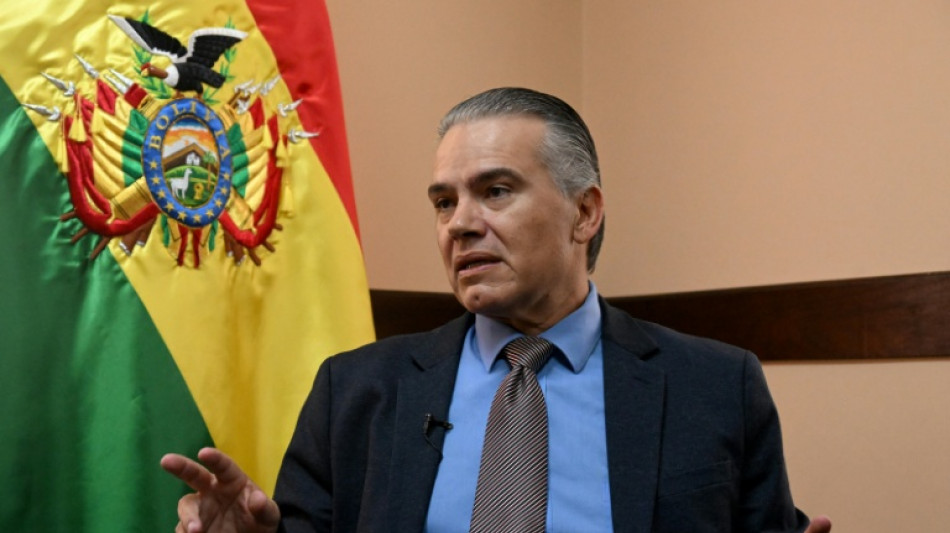
Bolivia says US drug agency to return to aid cocaine battle / Photo: Aizar RALDES - AFP
 Carrick backs Dalot after hostile reception from Manchester United fans

 Aston Villa Defy History With Rare Victory at Old Trafford

 Crowds Gather at San Francisco Park for Elizabeth Holmes Lookalike Tournament

 New 401k Gold IRA Investment Guide Explains the Best Way to Invest in Gold for Retirement (2026 Update)

 InterContinental Hotels Group PLC Announces Transaction in Own Shares - November 09
Opti Digital Launches NEXA, an AI-Powered Intelligence Layer
 Tintina Mines Intersects 460m at 0.50% CuEq at the Dos Amigos Copper-Gold Project in Chile

 Ispire Technology Inc. Reports First Quarter Fiscal Year 2027 Financial Results
 CoTec Holdings Corp. Notes HyProMag USA Advances North Texas Rare Earth Magnet Facility With First Major Equipment Delivery

 iPS Cell Research Accelerates Drug Discovery for ALS and Spinal Cord Injury

Bolivia's brand-new narcotics czar, Ernesto Justiniano, told AFP Friday the US Drug Enforcement Administration, expelled in 2008, will be returning to bolster the South American country's anti-cocaine campaigns.
Justiniano is part of the new administration of President Rodrigo Paz, a pro-business conservative who took office on November 8 after two decades of leftist rule.
Paz, 58, is aiming for a sharp political, economic, social and diplomatic shift away from the policies of leftist leaders blamed by many for Bolivia's economic collapse, with dollars in short supply and annual inflation over 20 percent.
In an interview with AFP Friday, Justiniano said "there is a political commitment" for the DEA to return to Bolivia, where he said cocaine production has spiraled out of control.
"International cooperation is fundamental," he added. "We will no longer be an isolated country, a country that is self-absorbed and acts solely out of political necessity."
The new government has set for itself the tasks of eradicating coca leaves -- the raw material for cocaine production -- and going after drug cartels.
According to United Nations data, Bolivia is the world's third-largest producer of coca and cocaine, after Colombia and Peru.
Ties with the United States were severed under former socialist leader Evo Morales, in office from 2006 to 2019.
Bolivia took a sharp turn to the left under Morales, nationalizing energy resources and making alliances with China, Russia and fellow leftists in Cuba, Venezuela and elsewhere in Latin America.
In 2008, Morales expelled the US ambassador and DEA officials, accusing them of interference in Bolivia's affairs. USAID officials followed in 2013.
Washington expelled Bolivia's ambassador in retaliation, and the envoys were never replaced.
Paz, an economist-turned-senator, vowed the day after his election victory to renew ties with Washington.
- No money for eradication -
Justiniano -- whose official title is deputy minister of social defense and controlled substances -- said Bolivia's cocaine production levels were alarming, with estimated annual production of about 300 tons.
The UN says Bolivia has 31,000 hectares of coca crops. Of these, about 22,000 hectares are legal -- grown to be chewed as a stimulant, brewed into a tea thought to combat altitude sickness or used in religious rituals.
Justiniano, 56, said modern processes had reduced the amount of coca required to make one kilogram (2.2 pounds) of cocaine by about half.
"With one hectare of illegal coca, I can produce more than double the cocaine than twenty years ago," he told AFP.
He added that Bolivia's ability to address the problem was limited, with helicopters and planes grounded due to a lack of money for insurance or spare parts.
"All incursions... are conducted by land," he stated.
"And once on site, they must travel on foot, even lacking fuel for vehicles."
Bolivia's economy is in recession, according to the World Bank.
G.Stevens--AMWN

