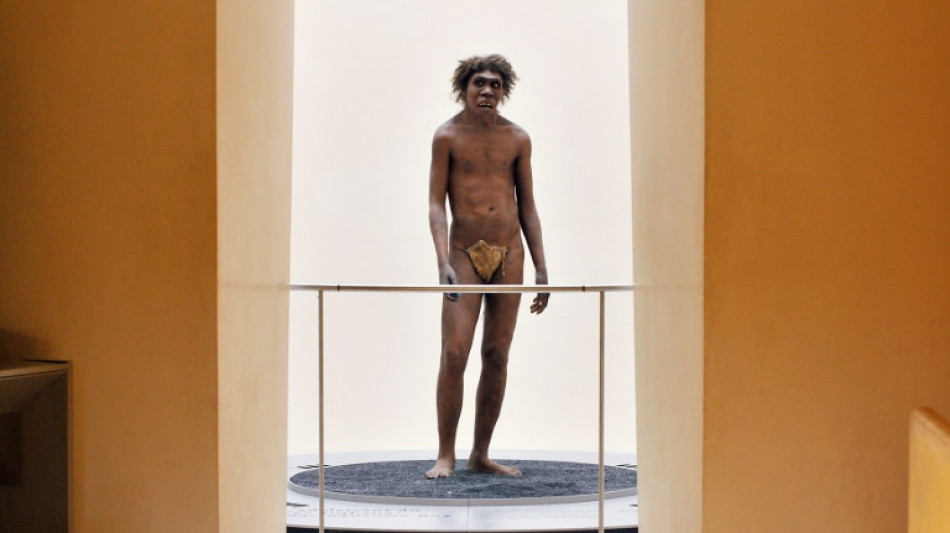
Fossils discovered in Morocco shed light on our African roots / Photo: PIERRE ANDRIEU - AFP/File
 Cash-strapped Senegalese unmoved by Youth Olympic Games

 Indonesia haze chokes neighbours, but little legal recourse

 Samad launches Pakistan into first Asian Games men's cricket final

 Yankees and White Sox advance, Phillies survive in MLB playoffs

 Asian stocks mixed as positive US data offset by elevated oil, bond yields

 Rice work: Dutch test new crop to save sinking peatlands

 Russians join street choirs to sing away sorrows -- or show dissent

 UK fears grow over AI giant Palantir's health service deal

 Empty nets in Latin America as fish flee El Nino

 Meidroth blasts White Sox through, Phillies survive in MLB playoffs

 'Catastrophic': Swiss glaciers lose fifth of mass in five years

 Great Western Mining Corporation PLC Announces Board Change & Appointment of New CFO

 California roller coaster shut after brain damage claims

 Panama ministers push for reopening of huge open-pit copper mine

 Bohm's blast keeps Phillies alive in MLB playoffs

 US judge accepts Paramount's Warner Bros. buyout settlement

 Global stocks mixed as markets weigh higher oil prices, bond yields

 Marsh hails improvements after Australia win final one-day international

 Hegseth says US cut number of generals, admirals by 20%

 Kanye West's Russian concerts have been cancelled, organisers say

 First Hollywood, now Fat Bear Week: nepobaby wins Alaska contest

 Barcelona lay down marker in Women's Champions League, Arsenal slip up

 US pushes against overproduction with eye on China at G20 meeting

 Swiss FA withdraws support for FIFA chief Infantino

 Man City's meteoric rise clouded by financial scandal

Where did our species first emerge? Fossils discovered in Morocco dating back more than 773,000 years bolster the theory that Homo sapiens originally appeared in Africa, scientists said in a study Wednesday.
The oldest Homo sapien fossils, dating from over 300,000 years ago, were found at the Jebel Irhoud northwest of Marrakesh.
Our cousins the Neanderthals mostly lived in Europe, while more recent additions to the family, the Denisovans, roamed Asia.
This has prompted an enduring mystery: who was the last common ancestor of Homo sapiens and our cousins, before the family tree split off into different branches?
This divergence is thought to have occurred between 550,000 and 750,000 years ago.
Until now, the main hominin fossils from around that time period were found in Atapuerca, Spain.
They belonged to a species dubbed "Homo antecessor", dated back around 800,000 years ago, and had features that were a mix of the older Homo erectus and those more similar to Homo sapiens and our cousins.
This sparked a contentious debate about whether our species originally emerged outside of Africa, before returning there.
There was "a gap in the fossil record of Africa", French paleoanthropologist and lead study author Jean-Jacques Hublin told AFP.
The research published in the journal Nature fills that gap by finally establishing a firm date for fossils discovered in 1969 inside a cave in the Moroccan city of Casablanca.
Over three decades, a French-Moroccan team unearthed hominin vertebrae, teeth and fragments of jaws that have puzzled researchers.
A slender lower jawbone discovered in 2008 proved particularly perplexing.
"Hominins who lived half a million or a million years generally didn't have small jawbones," Hublin said.
"We could clearly see that it was something unusual -- and we wondered how old it could be."
However numerous efforts to determine its age fell short.
- When Earth's magnetic field flipped -
Then the researchers tried a different approach.
Every once in a while, Earth's magnetic field flips. Until the last reversal -- 773,000 years ago -- our planet's magnetic north pole was near the geographic south pole.
Evidence of this change is still preserved in rocks around the world.
The Casablanca fossils were discovered in layers corresponding to the time of this reversal, allowing scientists to establish a "very, very precise" date, Hublin said.
This discovery eliminates the "absence of plausible ancestors" for Homo sapiens in Africa, he added.
Antonio Rosas, a researcher at Spain's National Museum of Natural Sciences, said it adds "weight to the increasingly prevalent idea" that the origins of both our species and the last common ancestor of Homo sapiens and Neanderthals/Denisovans lie in Africa.
"This work also suggests that the evolutionary divergence of the H. sapiens lineage might have started earlier than is conventionally assumed," Rosas, who was not involved in the research, commented in Nature.
Like Homo antecessor, the Casablanca fossils have a mix of characteristics from Homo erectus, ourselves and our cousins.
But while clearly closely related, the Moroccan and Spanish fossils are not the same, which Hublin said is a sign of "populations that are in the process of separating and differentiating".
The Middle East is considered to have been the main migration route for hominins out of Africa, however sinking sea levels at certain times could have allowed crossings between Tunisia and Sicily -- or across the Strait of Gibraltar.
So the Casablanca fossils are "another piece of evidence to support the hypothesis of possible exchanges" between North Africa and southwestern Europe, Hublin said.
M.A.Colin--AMWN