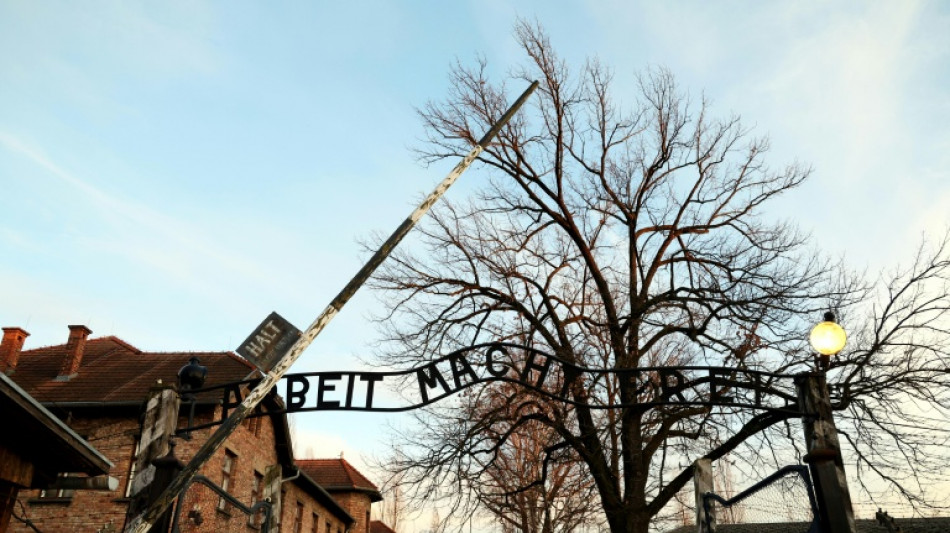
Clickbait and 'AI slop' distort memory of Holocaust / Photo: Dominique JACOVIDES - POOL/AFP
 Cable car offers small hope for Mongolia's gridlocked capital

 Man City scandal risks damage to Premier League's booming brand

 First-time Sepang F1 racers will master track 'from opening lap'

 Japan tightens rules for foreigners wanting permanent residency
 'Happiest moment': China's Mu first woman to win eSports Games gold
 EU talks deportations as five nations seek migrant centre in Africa
 Kenneth Branagh examines the scars of Iraq war in 'Atonement'

 Hundreds held, dozens wounded as French school protests escalate

 US government's new AI chatbot pulls back from debunking Trump

 US tennis star Navarro reveals health battle, ends season

 Panic, anger, tears: Evan Gershkovich's uneasy journey after Russian jail

 UK PM says 'strong indications' Iran involved in airbase incident
 Google restricts access to new AI model over safety concerns
 Watchdog clears former US Fed chief Powell in renovation probe

 Israel PM hails Indian pilot of rerouted flight for averting disaster
 Fury, Joshua kick off 'battle of Britain' in good spirits

 Ronaldo leaves Portugal training camp after coach says he is dropped
 Florence Pugh stars in 'East of Eden' adaption on Netflix

 Watchdog finds no criminal misconduct over US Fed renovations despite Trump probe
 In Manchester, City fans 'devastated' while rival fans call for relegation

 UK-France Channel migrant exchange deal scrapped: London

 Portugal boss denies 'incident' with Ronaldo

 Israel PM says one of the pilots of rerouted flight tried to crash plane

 Manchester City: Main points of damning judgement and possible sanctions

 Italy looking for 'identity' under Mancini says Scalvini
An emaciated and apparently blind man stands in the snow at the Nazi concentration camp of Flossenbuerg: the image seems real at first but is part of a wave of AI-generated content about the Holocaust.
As the world marks International Holocaust Remembrance Day on Tuesday, experts warn that such content -- whether produced as clickbait for commercial gain, or for political motives -- threatens efforts to preserve the memory of Nazi crimes.
AFP's Fact Check team has noted a surge of such imagery on social networks, distorting the history of Nazi Germany's murder of six million European Jews during World War II.
Among the AI-generated images that have gone viral is one of a little girl with curly hair on a tricycle.
She is presented as Hannelore Kaufmann, a 13-year-old Berliner who purportedly died at the Auschwitz extermination camp, of which the 1945 liberation by Soviet troops is commemorated on Tuesday.
However, there is no record of her ever having existed.
Another example is a fake image created to illustrate the invented story of a Czech violinist called "Hank" at Auschwitz, which was called out as false by the camp museum.
After early examples emerged in the spring of 2025, by the end of the year "AI slop" on the subject "was being shown very frequently", historian Iris Groschek told AFP.
On some sites such content was posted once a minute, said Groschek, who works at memorial sites in Hamburg, including the Neuengamme concentration camp.
With the exponential advances in AI, "the phenomenon is growing," said Jens-Christian Wagner, director of the foundation that manages the Buchenwald and Mittelbau-Dora memorials.
- Exploiting 'emotional impact' -
Several Holocaust memorials and commemorative associations this month issued an open letter warning about the rising number of these "entirely fabricated" pieces of content.
Some of them are churned out by content farms which exploit "the emotional impact of the Holocaust to achieve maximum reach with minimal effort".
The picture supposedly from Flossenbuerg camp falls into this category, as it was shown on a page claiming to share "true, human stories from the darkest chapters of the past".
The memorials warned that fake content was also being created "specifically to dilute historical facts, shift victim and perpetrator roles, or spread revisionist narratives".
Wagner points for example to images of "well-fed prisoners, meant to suggest that conditions in concentration camps weren't really that bad".
The Frankfurt-based Anne Frank Educational Centre warned of a "flood" of AI-generated content and propaganda "in which the Holocaust is denied or trivialised, with its victims ridiculed".
By distorting history, AI-generated images have "very concrete consequences for how people perceive the Nazi era", says Groschek.
The results of trivialising or denying the Holocaust are in evidence in the attitudes of some younger visitors to the camps, particularly from "rural parts of eastern Germany... in which far-right thinking has become dominant", said Wagner.
- 'Confident, loud, aggressive' -
Staff have observed Hitler salutes as well as other provocative and disrespectful actions and comments.
Such behaviour is only "by a minority, but a minority that is increasingly confident, loud and aggressive", he told AFP.
In their open letter, the memorials called on social media platforms to "proactively combat AI content that distorts history" and to "exclude accounts that disseminate such content from all monetisation programmes".
"The challenge for society as a whole is to develop ethical and historically responsible standards for this technology," they said, adding: "Platform operators have a particular responsibility in this regard."
German Culture Minister Wolfram Weimer said in a statement to AFP: "I support the memorials' call to clearly label AI-generated images and remove them when necessary."
He said that making money from such imagery should be prevented.
"This is a matter of respect for the millions of people who were killed and persecuted under the Nazis' reign of terror," he said, reminding the platforms that they had "obligations" under the EU's Digital Services Act.
Groschek said that none of the American social media giants responded to the memorials' letter, including Meta, the owner of Facebook and Instagram.
TikTok responded by saying it wanted to exclude the accounts in question from monetisation and implement "automated verification", according to Groschek.
Some of the fake Facebook posts about Hannelore and Hank were still online on the eve of Holocaust Remembrance Day.
D.Kaufman--AMWN