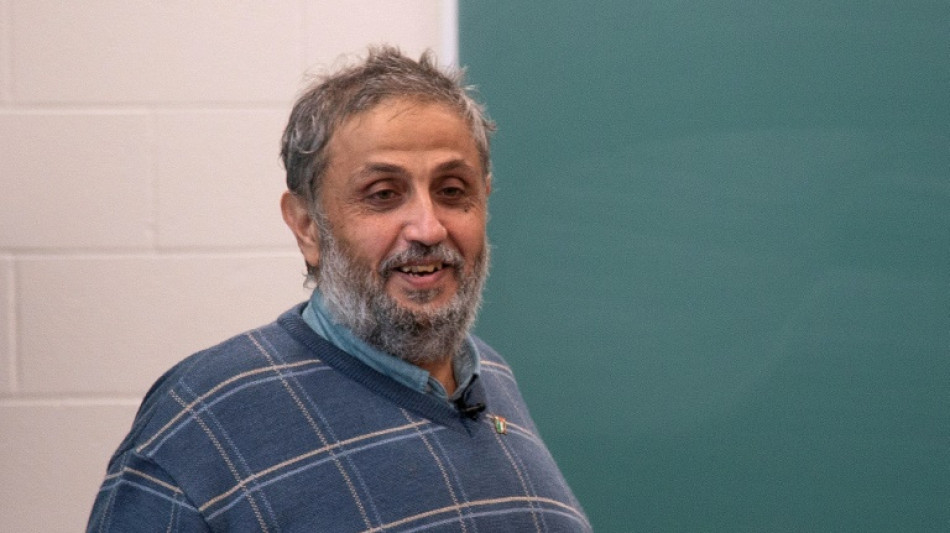
From Canada, professor tries to keep Gaza university 'alive' / Photo: Jorge Uzon - AFP
 Fiji appoint ex-Springboks boss White as coach ahead of World Cup

 Hungary to reverse Orban-era anti-LGBTQ legislation

 Allen rushes Bills to thrilling 37-34 win over Rams

 India youth shift tactics as police clamp down on election protest
 Malaysia's Firefly extends flight cancellations due to haze

 IMF upgrades 2026 growth forecast but warns of 'split' outlook
 Infantino could pull off 'Houdini' act as critics struggle for candidate

 France braces for fresh nationwide student demonstrations

 Ahead of Israel vote, desert town becomes frontline against ultra-Orthodox expansion

 El Nino Watch: the impacts around the world this week

 Man City, PSG clash at contrasting time for state-backed projects
 InterContinental Hotels Group PLC Announces Transaction in Own Shares - October 13

 Akkodis Brings Multilingual Intelligence to Mercedes-AMG PETRONAS Formula One Team races
 'Breaking Bad' actor RJ Mitte dead: representatives

 Former DR Congo president Kabila forms new force with M23 armed group
 Tom Cruise's 'Digger' tanks, leaving studio with $250 mn hole

 US actress Selma Blair arrested after flight altercation

 One dead as Hurricane Simon creeps along Mexico's Pacific coast

 Carrick's Man United 'hungry and eager' to fix worst start in decades

 Fury as US federal agents search anti-Trump lawmaker's home

 One goal enough for Flick as Barca enter Galatasaray cauldron
 A7 to unveil a service that will re-invent the international payments market

 'Status quo' with EU 'not good enough', UK PM says as summit date set
 Stolen Renoir paintings found behind wall in France

 French supermarkets suffer refrigerator shutdown after 'unprecedented' cyberattack

University professor Ahmed Abu Shaban often gets up at 3:00 am in Toronto to remotely teach his students in Gaza -- motivated by loyalty to his trapped pupils, and a deep sense of guilt.
Shaban, an academic who fled Gaza days after October 7, 2023, said he has an obligation to students in the Palestinian Territory desperate to study in defiance of unimaginable challenges.
He also said he has a responsibility to help preserve higher education in Gaza, while the world is focused on the humanitarian emergency.
But the 50-year-old conceded that guilt also weighs on him.
"Guilty for leaving Gaza," he told AFP. "Like we just abandoned our country, our people, our institution."
Shaban is still the dean of the Faculty of Agriculture and Veterinary Medicine at Al-Azhar University, which was destroyed -- along with most university buildings -- by Israeli air strikes.
Shaban crossed to Egypt shortly after the war began, anticipating Israel's response to the Hamas attack would be "massive," he said.
Canadian contacts arranged a posting at Toronto's York University, where he is a visiting professor in the Faculty of Environmental and Urban Change.
In a campus office with empty book shelves and mostly bare walls, Shaban explained that he felt compelled to help make Al-Azhar operational in some form.
He wanted "to give the very clear message for the whole world: Yes, they just destroyed our infrastructure. Yes, they destroyed our buildings... but we are still alive and we will just continue," he said.
"This is actually a responsibility for our students, for our nation, and for our independent state in the future."
- Hunger to study -
Shaban, who is on Al-Azhar's board, said its pre-war enrolment was 14,000 students.
When registration opened for online courses earlier this year he expected 1,000 students to join.
"We got 10,000," he said.
"It was really, for me, shocking because, just imagine: you live in a tent, you have no electricity, you have no internet. You have nothing at all.
"But you still have the hope to go to sign up for online courses and to walk for five (kilometres) to get internet connection and even to communicate, to sit and study. And sometimes you risk your life even while you are searching for internet."
Shaban conceded his personal schedule is "stressful," as he tries to work in two time zones.
One day last month, he was up at 3:00 am to join a workshop on Gaza's food system, before an Al-Azhar board meeting at 6:00 am. He then headed to his Toronto office to prepare a guest lecture on the Gaza war.
On evenings and weekends he records and uploads lectures for his Palestinian students.
Shaban said the study program is flexible, given the challenges of internet access. Students watch lectures and complete assigments when they can get online.
- Star student killed -
He said students in Gaza can be "angry" and "pushy": they want to know, for example, when they will able to do lab work, even though all the labs have been destroyed.
Shaban said he understands their frustrations.
"Sometimes you feel the students are looking at us like we can do things that actually are not doable," he said. "I have to be responsive in a gentle way."
As agitated student messages pour in, Shaban said he reminds himself that he is living comfortably in a city with electricity and grocery stores stocked with food.
"(I) try just to provide them with whatever support that I can. There are many things that I cannot do," he said.
Students who have died are always front of mind.
He recalled five engineering students killed as they gathered by an internet source to work on an assignment.
Shaban said he will never forget his "star student" Bilal al Aish, who, days before the war started, was trying to decide whether to pursue a scholarship in Germany or the American Fulbright.
"I saw the hope in his eyes, not only for his own future, but also the future of our institutions."
Shaban said Aish was killed by an Israeli strike early in the war.
"I got the feeling they are killing the future," the professor said. "That was really painful for me."
L.Mason--AMWN