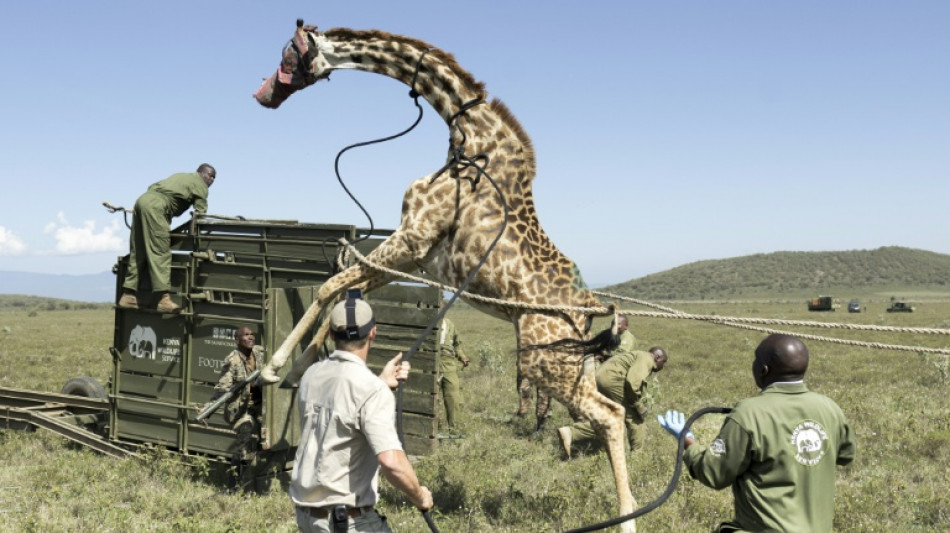
'Stranded, stressed' giraffes in Kenya relocated as habitats encroached / Photo: Tony KARUMBA - AFP
 Brennan sprints to Vuelta stage two victory, Pogacar keeps red
 Duplantis conquers pole vault at Silesia Diamond League

 France's badminton gold winners set for obscurity back home

 Brighton start Premier League season with rout of 10-man Villa

 Maresca makes winning start with Man City after dramatic fightback
 Mo'unga returns for All Blacks against Johannesburg Lions

 Belgian sprinter Philipsen wins Renewi Tour
 'A day for French badminton' as Lanier triumph gives them golden double at world champs

 Kane voted German footballer of the year

 'New season, new trim': Man City star Haaland chops off flowing locks

 Lanier clinches badminton world title in France's golden double
 After Wildberries, Ukraine launches drone campaign on Russia's Ozon

 Padikkal, Gill half-centuries take India to 187-3 at tea

 Cummins hails 'sharp' Australia as they get back to winning ways
 Bangladesh eye more Australia Tests to hit next level

 Thousands expected at Sweden climate demo as election looms

 Starc heroics put Australia on brink of victory over Bangladesh

 Austrian mountain town finds niche in AI boom

 Messi scores but Miami slump continues with loss to Toronto

 Sydney marathon unveils medal with wrong stadium

 Macron hosts Saudi's MBS for visit ranging from esports to Mideast

 Australia in control with 146-run first innings lead over Bangladesh

 World No. 3 Pegula beats defending champ Swiatek to reach Cincy final

 Wyndham Clark surges clear at BMW Championship

 Maresca says Man City must fill Rodri void after Barca switch

Coaxed and tugged by rangers, a blindfolded giraffe totters into the specialised vehicle that will transport it away from an increasingly hostile environment to a new home in Kenya's eastern Rift Valley.
Such relocations are a last resort when human activities or climate change threaten the survival of wildlife or peaceful coexistence with humans, say conservationists.
But the complex operations, overseen by Kenya Wildlife Service (KWS), are becoming more and more frequent in the east African country.
In recent weeks, hundreds of giraffes, zebras, and antelopes have been removed from the Kedong Ranch, on the shores of tourist hotspot Lake Naivasha.
The land had been left in its natural state, but over the years has been sold and subdivided into plots for real estate development, preventing the animals from grazing or using the natural corridor between Mount Longonot and Hells Gate.
"The animals began to suffer. They were stranded, stressed," said KWS's Patrick Wambugu, describing the construction of fences blocking the giraffes' route.
On Sunday, Wambugu's team relocated five giraffes in an operation that required dozens of people, trailers, a plow -- and even a helicopter that tracked the animals across the plains, before shooting them with tranquiliser darts.
KWS veterinarian Dominic Mijele, who was part of the operation, told AFP the giraffe is the most difficult animal to move, the risks "numerous".
The long-limbed creatures face deadly falls after being tranquilised and, despite their gentle appearance, can deliver a fierce kick to those trying to help.
They are also highly sensitive to anaesthesia and so cannot be kept sedated for long, a result of their unique build -- "the heart to the brain is quite long," Mijele explained.
As such, the rangers have to physically immobilise the creatures before they can be blindfolded and transported.
Once secured, the convoy travels the roughly 30 kilometres separating the ranch from their new home in the Oserengoni private reserve.
Once in there, a veterinarian will observe them for a week, although they usually establish their territory within two days.
"We hope that in the coming years the numbers will multiply, and they will be able to thrive in this landscape," said Mijele.
- Dilemma -
Similar operations are carried out almost every month in Kenya, said Mijele, mainly due to environmental destruction.
However, human-wildlife conflicts are also on the rise.
Kenya's population has soared from 30 million in 2000 to roughly 56.4 million in 2024, according to the World Bank.
Land privatisation is common and goes hand-in-hand with rampant speculation.
Humans often settle in areas that are also refuges for wildlife, said Evan Mkala, programme manager in eastern Kenya for the International Fund for Animal Welfare (IFAW).
The area around Lake Naivasha is being "invaded" by people, he said bluntly, leading to costly relocations when a "critical point" is reached.
This is happening with increasing frequency.
In a country with hundreds of national parks and private reserves, which generate significant tourism revenue, the challenge is to "reconcile" population growth, economic development, and wildlife conservation, said Philip Muruthi, vice president of the African Wildlife Foundation.
"Africa doesn't have to choose between wildlife conservation, nature protection, and development," he said, underscoring that the well-being of humans and animals is "inseparable".
O.Norris--AMWN