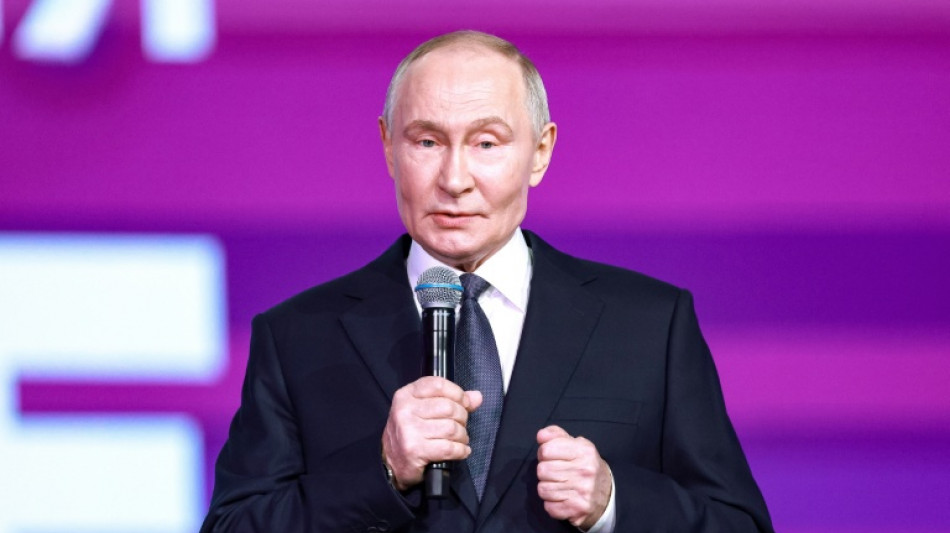
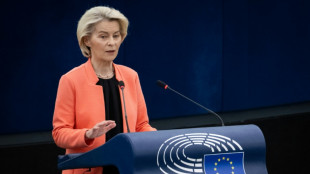
Most EU citizens see 'high risk' of war with Russia: poll / Photo: Alexander SHCHERBAK - POOL/AFP
 North Korean women crowned Asian club champions in South

 Full steam ahead for Milei's Andean mining revolution
 Rubio in India to renew ties after Trump's China lovefest

 China set for latest space launch, with Hong Kong astronaut aboard
 US jury finds Boeing not guilty in 737 MAX grounding lawsuit
 Rubio starts first visit to India on heels of US-China summit
 'Never going back': Cartel attack decimates Mexican Indigenous town

 The movies vying for the Cannes Film Festival's top prize

 Banned ex-100m champ Kerley to compete clean at Enhanced Games

 Senegal's president sacks PM after months of tensions
 US mulls new strikes on Iran: US media reports
 SpaceX sends Starship rocket sailing into space
 Russell bounces back to beat Antonelli in sprint qualifying

 Mexico, EU lower tariffs in bid to grow non-US trade

 Fresh confrontation between police, protesters in Bolivia
 US Fed chair says will be 'reform-oriented' at glitzy White House swearing-in
 Ace, eagle lift Im to early CJ Cup Byron Nelson lead

 Antonelli romps opening practice ahead of Russell
 Pakistan military chief arrives in Tehran in push to end Iran war

 US intelligence chief Tulsi Gabbard resigns

 Pep 'made me believe I could be a coach', says Kompany
 Rising Spain star Jodar wants to 'follow own path' at Roland Garros

 Success fuels Guardiola's campaign for a 'better society'
 SpaceX to retry Starship test launch Friday

 Stocks gain, oil higher as investors weigh Mideast peace prospects

A majority of citizens across nine EU countries see a high risk of war breaking out between the bloc's members and Russia, according to a survey by polling group Cluster 17 published Thursday in the French international affairs journal Le Grand Continent.
The poll's findings, based on a sample of almost 10,000 people from the nine countries, come more than three-and-a-half years into the conflict sparked by Russia's 2022 full-scale invasion of Ukraine and amid fears the war could spread further.
France's top general Fabien Mandon last month warned Russia was preparing for a new confrontation by 2030. Russian President Vladimir Putin said Tuesday that if Europe wants war "we are ready right now".
The poll showed 51 percent of respondents believe there is a "high" or "very high" risk that Russia could go to war with their country in the coming years. The study was conducted with a sample of 9,553 people at the end of November.
The countries involved in the study were France, Germany, Italy, Spain, Poland, Portugal, Croatia, Belgium and the Netherlands, with samples of more than 1,000 people in each country.
The fear of open conflict with Russia varied.
In Poland, which has borders with Russia and its ally Belarus, 77 percent of respondents considered the risk high or very high.
This figure dropped to 54 percent in France and 51 percent in Germany.
Meanwhile, 65 percent of Italian respondents considered the risk low or nonexistent.
A large majority of 81 percent, meanwhile, said there is little or no chance of a war with China in the coming years.
With a debate intensifying in Europe over military service and France reintroducing a form of voluntary military service, respondents expressed doubt over the capabilities of their armed forces against Moscow.
Sixty-nine percent said their country would be "not at all" or "not likely" capable of defending itself against Russian aggression.
In France -- the only country in the survey to have nuclear weapons -- respondents were the least pessimistic, with 44 percent believing their country is "quite" or "fairly" capable of defending itself.
At the other end of the table were the Belgians, Italians, and Portuguese, who overwhelmingly believe -- at 87 percent, 85 percent and 85 percent respectively -- their countries were incapable of defending themselves.
"Terrorism" remained the most immediate threat in European public opinion. Across the nine countries covered by the survey, 63 percent of respondents considered the risk of open war with "terrorist" groups to be "high" or "very high", according to the poll.
P.M.Smith--AMWN