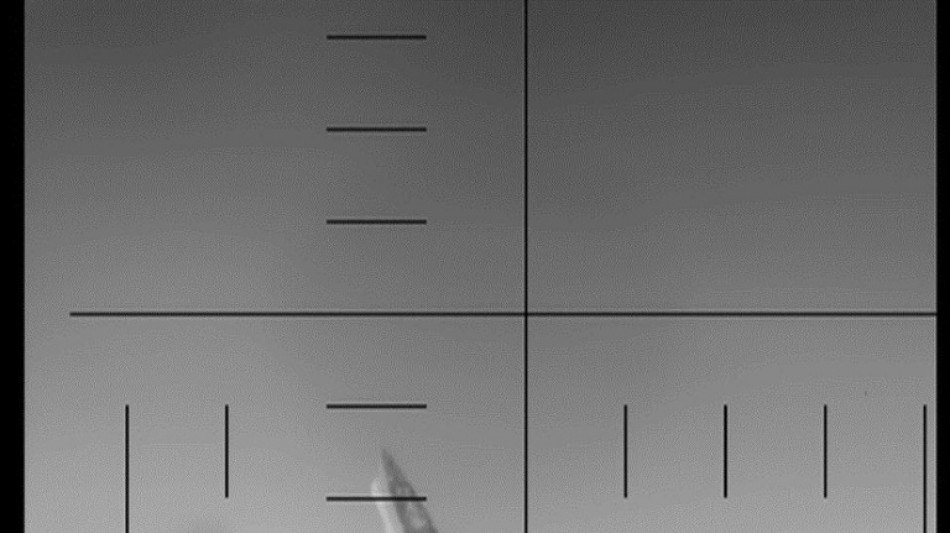
Who rules the seas? Torpedoed Iran ship brings focus underwater / Photo: - - US Department of Defense/AFP
 Russian strike kills 14 around Kyiv on eve of NATO summit
 USA face Belgium and World Cup date with destiny after Balogun reprieve

 Immobilised by heatwave, handicapped man sues Austria in rights court
 Bellingham tells England to believe after Mexico masterclass

 'Major' damage as super typhoon hits US islands

 Kane says England found a way to win
 England, Norway advance at World Cup, FIFA ruling triggers uproar

 Asian markets mixed as tech recovery stutters, oil slips

 Russia launches deadly barrage on Kyiv region on eve of NATO summit

 'Major' damage as Super Typhoon Bavi hits US island of Rota
 Australia signs defence alliance with Pacific nation Fiji

 Philippine Senate trial to decide VP Duterte's political future

 Australia PM apologises for Kylie Minogue comments

 Grande Portage Resources Reports Positive Results from Preliminary Strength Testing of Mine Backfill Materials

 InterContinental Hotels Group PLC Announces Transaction in Own Shares - July 06

 Mexico-England World Cup match delayed one hour due to storms
 Gotterup wins PGA John Deere after Kohles splashdown
 Haaland knocks Brazil out of World Cup as Norway reach quarters

 'Catastrophic' Super Typhoon Bavi hits US island of Rota

 West Indies trail Sri Lanka by 231 runs
 FIFA clear US star Balogun to play after Trump call

 Venezuela quake survivor 'reborn' after eight days in rubble
 Red-card U-turn rocks World Cup as England face Azteca test
 Struff oldest first-time men's Slam quarter-finalist in Open era
 Banana!: 'Minions' knocks 'Toy Story' off N.America box office perch
A US submarine this week torpedoing an Iranian warship during the Middle East conflict raised the crucial question of who controls the seas during wartime.
The sinking of IRIS Dena on Wednesday in international waters off the coast of Sri Lanka killed at least 86 crew members, in what Iranian Foreign Minister Abbas Araghchi labelled an "atrocity".
It came after US-Israeli strikes on Iran on Saturday triggered war in the Middle East, with the Islamic republic launching retaliatory attacks across the region and beyond.
The US Navy had not torpedoed a ship since 1945.
Washington afterwards released what it said was periscope footage of the submarine firing on the ship, and an image of its hull almost vertical as it slipped below the surface.
The IRIS Dena "sank in less than 20 minutes", said Alessio Patalano, a professor at King's College London.
"It didn't stand a chance. The incident confirms the sophistication of the means of American undersea warfare."
Patalano said "submarine warfare has never gone away."
"It was just in the background because there hasn't been a confrontation between fleets since the 1980s," he added.
- 'Ultimate wartime weapon' -
The most recent confirmed wartime torpedo attack dates back to 1982, when the British submarine HMS Conqueror sank the Argentine cruiser Belgrano during the Falklands War.
In 2010, South Korea's Cheonan corvette was torpedoed -- an attack Seoul attributed to North Korea, but which Pyongyang denied.
A European military source specialising in submarines and speaking on condition of anonymity explained that a torpedo explodes underneath a ship rather than upon contact with it.
"It detonates a few metres below, creating a huge air bubble that lifts the vessel and breaks its main beam in two when it comes back down," the source said.
IRIS Dena's sonar range was probably too limited to have been able to detect the threat, they added.
The stealthy, invisible manoeuvres of a submarine, paired with its ability to fire torpedoes from dozens of kilometres away, make it "the ultimate wartime weapon", according to the source.
These capabilities can make a difference when surface combat between navies of similar standing is "symmetrical, with radars and missiles of roughly equivalent range".
Patalano said countries with a sophisticated underwater force enjoy an "objective advantage" in the event of a naval confrontation.
- 'We are everywhere' -
Another European military source, also speaking anonymously, said conducting the attack far from the conflict's epicentre was a "show of force aimed at major rivals" such as China and Russia.
"Attacking this ship in international waters... means: 'We, the Americans, dominate the air, the sea and the undersea. We are everywhere, able to find you and destroy you.'"
Experts suggest that while Russia has neglected the modernisation of its surface fleet -- signalled by its setbacks in the Black Sea throughout its war with Ukraine -- it has made a point of investing in its submarine fleet.
China has been developing its navy and submarines for years.
US submarine forces commander Vice Admiral Richard Seif told an American congressional committee this week that China's "formidable" next-generation submarines "challenge the US Navy's longstanding undersea dominance".
A.Malone--AMWN