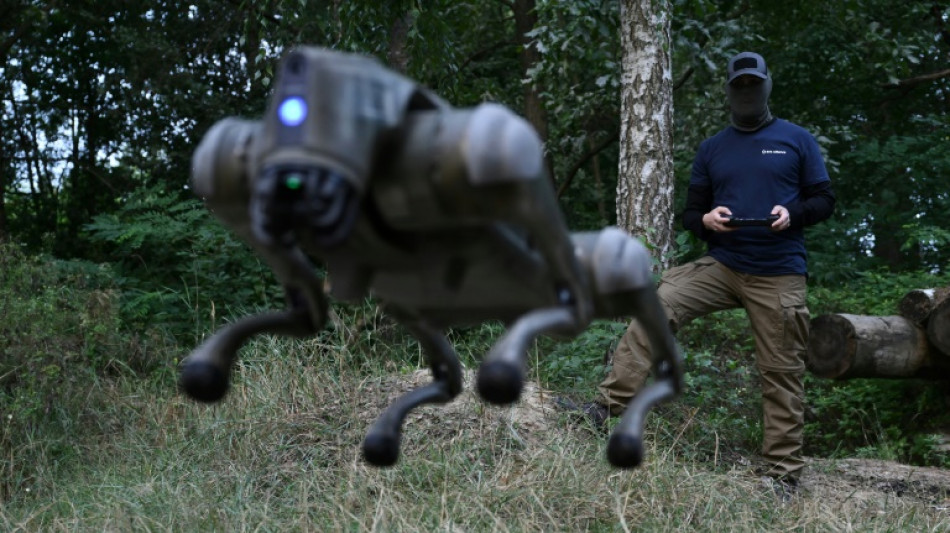
Ukraine to unleash robot dogs on its front lines / Photo: GENYA SAVILOV - AFP
 Brussels Education Unions Schedule Major November Protest Over Funding and Reforms

 iPS Cell Research Accelerates Drug Discovery for ALS and Spinal Cord Injury

 Rene Eyre Revisits Autobiographical Performance 'Say A Little Prayer' in London

 UAE's HCT Holds Record Graduation and Announces Major Training Expansion

 NASA Awards $10B Lunar Contract Framework to SpaceX, Blue Origin

 Katy Perry Tells Fans Ex-Husband Russell Brand 'Should Be in Jail' During UK Concert

Ukraine could soon unleash robot dogs on its front lines, replacing soldiers for perilous missions like spying on Russian trenches or detecting mines.
At a demonstration in an undisclosed part of Ukraine, the metallic dog known as model "BAD One" stood up, crouched, ran and jumped according to commands transmitted by its operator.
Stealthy and agile, they could soon become an invaluable ally on the front line for an Ukrainian army that is short on manpower to repel the Russian invasion, its makers said.
Low on the ground and therefore difficult to detect, the robot dogs can use thermal imaging to inspect enemy trenches or the inside of buildings in combat zones.
"We have surveillance soldiers who get sent on reconnaissance missions (who) are most of the time very highly trained people, very experienced people (and) always exposed to risks," said the operator who called himself "Yuri", as he showed it off to AFP journalists.
"This dog limits the risk for soldiers and increases operational capabilities. This is the core function of the dog," said the operator, who works for a British company providing military equipment.
A more advanced model, known as "BAD Two" could not be shown for security reasons.
The device used in the demonstration has a battery that powers it for around two hours.
Useful for detecting mines or improvised explosive devices, the robot dog can also be used to carry up to seven kilos (15 pounds) of ammunition or medicines to hot spots on the battlefield.
"I can't say how many we deployed" in Ukraine, Yuri said, adding: "But it will have a significant impact on the operations and increase the safety of soldiers."
And if the robot dogs were ever to fall into Russian hands, he said, an emergency switch allows the operator to erase all its data.
P.Silva--AMWN

