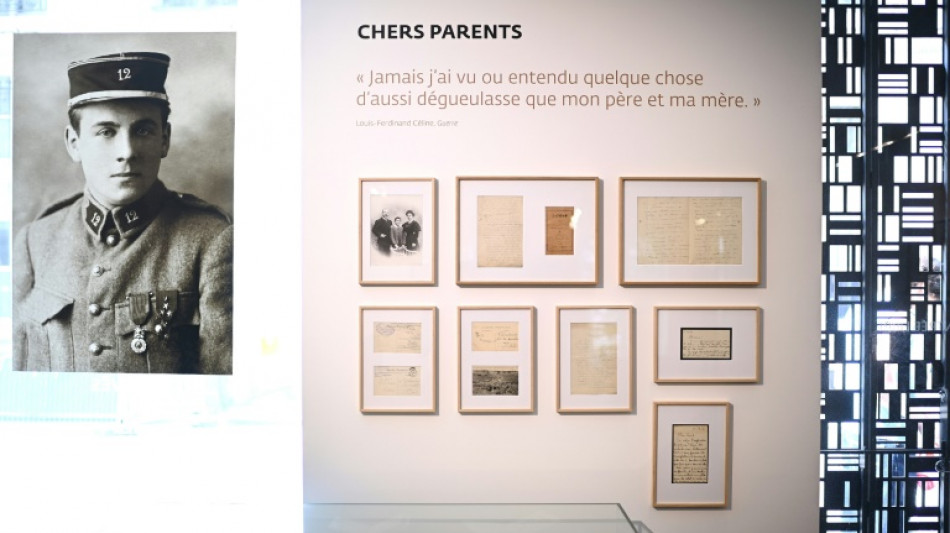
France's pro-Nazi literary legend returns 78 years on / Photo: Christophe ARCHAMBAULT - AFP
 Morning Roundup: Cycling Classic Returns as Cruise Port Opens and Plant Library Grows

 Cowbells Mark Return of Philadelphia Cycling Classic for Carpenter Family

 Apprenticeship Awards Name Derbyshire and Nottinghamshire Finalists

 £1m Dental Foundation Launches Mobile Care for Vulnerable People

 Firebloom EP01 Delivers Fast Stone-Baked Pizza Indoors and Outdoors

 Family-Run Cafe Opens Second Nottingham City Centre Location

 Aldi Sets Reduced Hours for August Bank Holiday

 UK Moves 2026 Boxing Day Bank Holiday to Monday

 HMS Belfast Exhibition Revisits the Final Days Before D-Day
 Barnum Musical Returns With Circus Spectacle

 London Marathon Two-Day Plan Raises Questions Over 2027 Disruption

 Wormwood Scrubs Failings Found After Wife's Urgent Warning Went Unheeded

 London Kids' Open-Top Bus Tour Offers Family Alternative to the Tube
 London Couple Cuts Annual Spending by £1,600 Without Giving Up Travel

 Dubai Investor Explains Dh50,000 Monthly Draw and Long-Term Strategy

 Oil Traders Weigh Iran War Risk Against Diplomatic Signals

 US Cancels Taif Sami Mohammed's Visa and Adds Her to Watchlist

 Tamil Nadu Assembly Clash Continues Over 10.5% Vanniyar Reservation

 Chennai Police Arrest Mother and Daughter Over ₹40 Lakh Chit Fund Case

 PSBB K.K. Nagar Pair Wins Madras Quiz

 Chennai Hospital Opens Upgraded Holistic Wellness Facility

 Okinawan Festival Returns With Revised Convention Center Format

 Hawaiʻi Supreme Court Ruling Removes Waters From Council Contest

 Consolidated Theatres Launches Hawaiʻi-Made Film Series in September

 Iceland votes on whether to resume EU membership talks

It is a rare thing when the story of a book's publication is even more mysterious than the plot of the novel itself.
But that might be said of "Guerre" (War) by one of France's most celebrated and controversial literary figures, Louis-Ferdinand Celine, which arrives in bookstores on Thursday, some 78 years after its manuscript disappeared.
Celine's reputation has somehow survived the fact that he was one of France's most eager collaborators with the Nazis.
Already a superstar thanks to his debut novel "Journey to the End of the Night" (1932), Celine became one of the most ardent anti-Semitic propagandists even before France's occupation.
In June 1944, with the Allies advancing on Paris, the writer was forced to abandon a pile of his manuscripts in his Montmartre apartment.
Celine expected rough treatment, having spent the war carousing with the Gestapo, fingering Jews and foreigners to the authorities and publishing racist pamphlets about Jewish world conspiracies.
For decades, no one knew what happened to his papers, and he angrily accused resistance fighters of burning them.
But at some point in the 2000s, they ended up with retired journalist Jean-Pierre Thibaudat, who passed them -- completely out of the blue -- to Celine's heirs last summer.
- 'A miracle' -
Despite this unsettling history, the reviews of the resulting 150-page novel, published by Gallimard, have been unanimous in their praise.
"The end of a mystery, the discovery of a great text," writes Le Point; a "miracle," says Le Monde; "breathtaking," gushes Le Journal du Dimanche.
Gallimard has yet to say whether there will be a translation.
Like much of Celine's work, it is deeply autobiographical, recounting his terrible experiences during World War I.
It opens with 20-year-old Brigadier Ferdinand finding himself miraculously alive after waking up on a Belgian battlefield, follows his treatment and hasty departure for England -- all based on Celine's real experiences.
His time across the Channel is the subject of another newly discovered novel, "Londres" (London), to be published this autumn.
If French reviewers seem strangely reluctant to focus on Celine's anti-Semitism, it is partly because his early writings ("Guerre" is thought to date from 1934) show little sign of it.
"Journey to the End of the Night" was actually a hit among progressives for its anti-war message, as well as a raw, slang-filled style that stuck two fingers up at bourgeois sensibilities.
Celine's attitude to the Jews only revealed itself in 1937 with the publication of a pamphlet, "Trifles for a Massacre", which set him on a new path of racial hatred and conspiracy-mongering.
He never back-tracked. After the war, he launched a campaign of Holocaust-denial and sought to muddy the waters around his own war-time exploits -- allowing him to worm his way back into France without facing any repercussions.
- 'Divine surprise' -
Many in the French literary scene seem keen to separate early and late Celine.
"These manuscripts come at the right time -- they are a divine surprise -- for Celine to become a writer again: the one who matters, from 1932 to 1936," literary historian Philippe Roussin told AFP.
Other critics say the early Celine was just hiding his true feelings.
They highlight a quote that may explain the gap between his progressive novels and reactionary feelings: "Knowing what the reader wants, following fashions like a shopgirl, is the job of any writer who is very financially constrained," Celine wrote to a friend.
Despite his descent into Nazism, he was one of the great chroniclers of the trauma of World War I and the malaise of the inter-war years.
An exhibition about the discovery of the manuscripts opens on Thursday at the Gallimard Gallery and includes the original, hand-written sheets of "Guerre".
They end with a line that is typical of Celine: "I caught the war in my head. It is locked in my head."
In the final years before his death in 1961, Celine endlessly bemoaned the loss of his manuscripts.
The exhibition has a quote from him on the wall: "They burned them, almost three manuscripts, the pest-purging vigilantes!"
This was one occasion -- not the only one -- where he was proved wrong.
P.Stevenson--AMWN