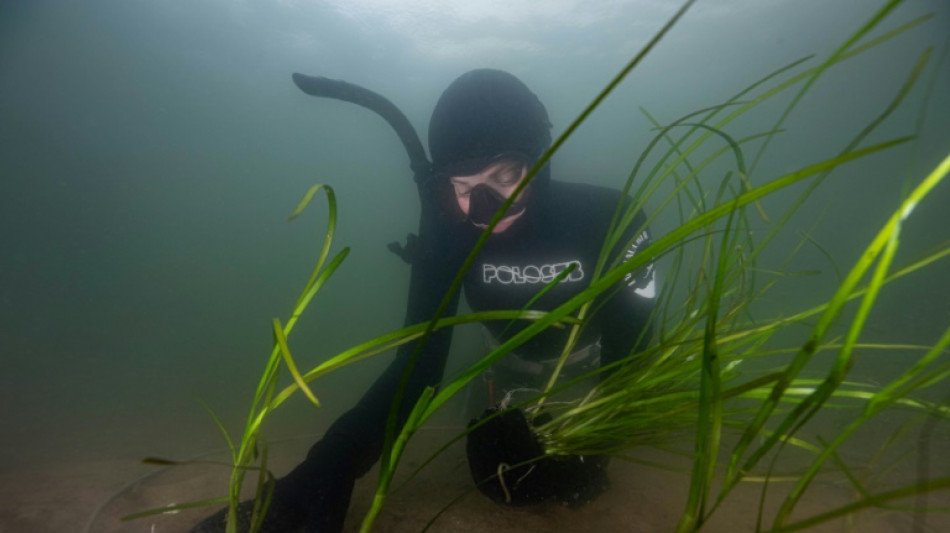
Researchers discover 1,400-year-old seagrass in Finland / Photo: Helene-Julie Zofia PAAMAND - Underwater Ambassador/AFP
 Brussels Education Unions Schedule Major November Protest Over Funding and Reforms

 iPS Cell Research Accelerates Drug Discovery for ALS and Spinal Cord Injury

 Rene Eyre Revisits Autobiographical Performance 'Say A Little Prayer' in London

 UAE's HCT Holds Record Graduation and Announces Major Training Expansion

 NASA Awards $10B Lunar Contract Framework to SpaceX, Blue Origin

 Katy Perry Tells Fans Ex-Husband Russell Brand 'Should Be in Jail' During UK Concert

Scientists have discovered the world's oldest known seagrass in Finland, using a new method to determine the age of aquatic plants that put it at 1,403 years old, they said this week.
By measuring the number of genetic mutations occurring over time in seagrass -- which reproduces by cloning itself over and over again, the scientists were able to determine the age of the original ancestor plant with groundbreaking precision.
"This is the first really reliable clone age estimate", study co-author Thorsten Reusch told AFP on Thursday.
The study was published in the scientific journal Nature Ecology and Evolution in June.
Researchers used the new method, dubbed a "genetic clock", at 20 sites across the world and found that a lush underwater meadow of eelgrass -- a species of seagrass -- in the Finnish coastal waters of the Baltic Sea was 1,403 years old, the most ancient marine plant currently known.
"In a way, we now have a clock that can determine to which seed and eventually which seedling a plant dates back to", Reusch said.
The ability to determine the age of plants unravels eye-opening information about how ecosystems function and about ageing processes in the natural world, he explained.
"It is interesting to understand how they avoid ageing symptoms over thousands of years.
"Ultimately it may even give us some clues on how to deal with ageing in humans", he continued.
- Valuable ecosystem -
"I am very positive that we will find clones that are 10,000 years or older".
Reproducing through flowers, seeds and rhizomes in the sediment, eelgrass populations provide important marine environments for other organisms and store carbon dioxide in stems and roots.
"Eelgrass is the most valuable ecosystem in the Baltic Sea," Reusch said.
Despite the staggering age and resilience demonstrated by the ancient plant, eelgrass is a threatened species in the Baltic Sea -- characterised by shallow, brackish waters and encircled by eight countries.
Nutrient pollution from industries like agriculture and forestry, coupled with rising sea temperatures due to climate change, have exacerbated the plight of the eelgrass populations.
"In the western Baltic Sea where I work, about 60 percent of the eelgrass has been lost in the last 100 years", Reusch said.
The sea is bordered by the three Baltic states, Finland, Germany, Poland, Russia and Sweden.
L.Davis--AMWN

