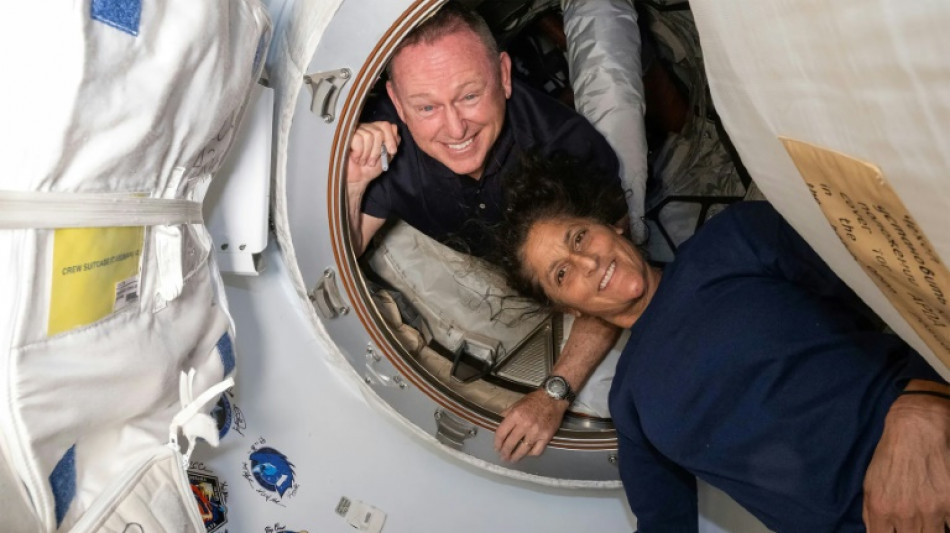
NASA to decide stranded Starliner astronauts' route home by end of month / Photo: Handout - NASA/AFP/File
 Brussels Education Unions Schedule Major November Protest Over Funding and Reforms

 iPS Cell Research Accelerates Drug Discovery for ALS and Spinal Cord Injury

 Rene Eyre Revisits Autobiographical Performance 'Say A Little Prayer' in London

 UAE's HCT Holds Record Graduation and Announces Major Training Expansion

 NASA Awards $10B Lunar Contract Framework to SpaceX, Blue Origin

 Katy Perry Tells Fans Ex-Husband Russell Brand 'Should Be in Jail' During UK Concert

NASA needs to decide by the end of August whether to return two astronauts to Earth aboard Boeing's Starliner, which flew them to the International Space Station (ISS), or bring them home on a SpaceX craft, officials said Wednesday.
NASA astronauts Barry "Butch" Wilmore and Sunita "Suni" Williams blasted off for the ISS on Starliner on June 5 for what was meant to be an eight-day stay.
But their return has been delayed by thruster malfunctions that came to light during the first crewed mission to the ISS by the Boeing spacecraft.
NASA officials, at a press conference on Wednesday, said they were still analyzing thruster data, but a decision on whether to use Starliner or Boeing's rival SpaceX was looming.
"We're reaching a point where that last week in August we really should be making a call, if not sooner," said Ken Bowersox, associate administrator of NASA's Space Operations Mission Directorate.
Bowersox said the astronauts were "making the best" of their extra time aboard the ISS "but I'm sure they're eager for a decision, just like the rest of us."
The main issue is with the propulsion system. "Our big concern is having a successful deorbit burn," the NASA official said.
Bowersox said there have been "very honest discussions" with Boeing and the US aerospace giant is "100 percent behind their vehicle."
In the event a decision is made not to use Starliner, Boeing's rival SpaceX, owned by Elon Musk, could potentially launch their scheduled Crew-9 mission to the ISS on September 24 with just two astronauts rather than the usual four.
The Crew Dragon capsule would then be able to return to Earth with Wilmore and Williams in February 2025 -- in what would amount to a major embarrassment for Boeing.
- 'Might not be perfect' -
NASA chief astronaut Joe Acaba said Wilmore and Williams prepared for the mission knowing it was a test flight and "might not be perfect."
"Human space flight is inherently risky and as astronauts we accept that as part of the job," he said. "As professional astronauts they're prepared for this and they're doing great."
Wilmore, the mission commander, had spent 178 days in space prior to the Boeing mission, while Williams, the pilot, had even more experience, with 322 days under her belt
In the event of an emergency aboard the ISS, Bowersox said Starliner could be used to bring the astronauts home.
"We think the risk is reasonable to put Butch and Suni on that vehicle in a contingency," Bowersox said.
- Boeing vs SpaceX -
If Starliner returns home uncrewed, an option in an emergency would be to use the four-person SpaceX Dragon capsule currently docked at the ISS.
But there are currently four other astronauts aboard the ISS and Wilmore and Williams would have to make the return flight without suits.
"Once Crew-9 gets there we'll have suits," said Joel Montalbano, deputy associate administrator of NASA's Space Operations Mission Directorate. "They would come home suited on Crew-9."
If Wilmore and Williams return with SpaceX, it would mark the biggest setback to date for Boeing's space program.
Both Boeing and SpaceX were awarded multibillion-dollar contracts in 2014 to provide the US space agency with rides to the ISS following the end of the space shuttle program in 2011, which left the United States reliant on Russian Soyuz rockets to ferry its crew.
SpaceX succeeded in its first crewed test in 2020 and has carried dozens of astronauts since.
P.Stevenson--AMWN

