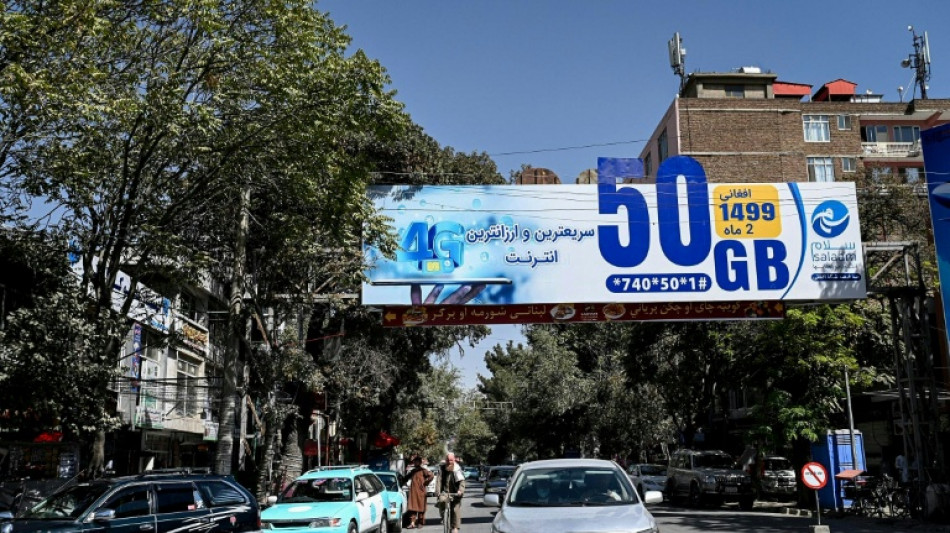
Mobile and data networks return across Afghanistan: AFP journalists / Photo: Wakil KOHSAR - AFP
 South African election results renew debate over identity-based voting

 South African voters report smoother local election but declining IEC trust

 Dolly Parton museum and Nashville hotel open after singer’s death

 George and Amal Clooney attend New York political-comedy reading

 British buyers pay substantial premiums for period-home appearance

 Thomas Markle released to house arrest after child-abuse-image charge

 Dawn of War 4 developers chose Adeptus Mechanicus for tactical variety

 Italy face unbeaten South Africa in Turin Nations Championship match

 ChatGPT interactive interface feature tested across six custom tools

 Freshways milk-price cut deepens pressure on UK dairy farms

 Labour and National remain virtually tied as New Zealand vote count advances

 The Good Daughter adapts Karin Slaughter thriller with Rose Byrne and Meghann Fahy

 Heavy-lift drone evacuates wounded Ukrainian soldier from frontline kill zone

 Morrison says West Brom recovered after pressure from successive derby losses

 Britain considers 2027 state visit for Ukraine’s Zelensky

 Anna Miltina Confronted with Racism Allegations on ProSieben Show

 German Auto Giants Face Existential Crisis as China Sales Plummet

 Cause of Death Revealed for 'Ellen' Producer Matthew Wright
Mobile networks returned to several provinces across Afghanistan on Wednesday, including the capital Kabul, 48 hours after the Taliban authorities shut down telecommunications.
Confusion gripped the South Asian country on Monday night when mobile phone service and the internet went down.
The massive blackout came weeks after the government began cutting high-speed internet connections to some provinces to prevent "immorality", on the orders of shadowy supreme leader Hibatullah Akhundzada.
AFP journalists reported on Wednesday that mobile phone signals and wifi had returned to provinces across the country, including Kandahar in the south, Khost in the east, central Ghazni, and Herat in the west.
The Taliban government has yet to comment on the telecommunications shutdown.
It is the first time since the Taliban government won their insurgency in 2021 and imposed a strict version of Islamic law that communications have been cut in the country.
Netblocks, a watchdog organisation that monitors cybersecurity and internet governance, said the blackout "appears consistent with the intentional disconnection of service".
It said connectivity had slowed to one percent of ordinary levels.
A government official warned AFP minutes before the shutdown on Monday evening that the fibre optic network would be cut, affecting mobile phone services, "until further notice".
There were widespread closures of businesses, airports, and markets, while banks and post offices were unable to operate.
Afghans were unable to contact each other in or out of the country, and many families stopped their children from going to school during the uncertainty.
Those living in Herat and Kandahar travelled to border towns to catch signals from neighbouring Iran and Pakistan.
The United Nations said on Tuesday the shutdown "left Afghanistan almost completely cut off from the outside world", and called on authorities to restore access.
Internet connections have been extremely slow or intermittent over the past weeks.
On September 16, when the first internet services were first cut in northern provinces, Balkh provincial spokesman Attaullah Zaid said the ban had been ordered by the Taliban's leader.
"This measure was taken to prevent vice, and alternative options will be put in place across the country to meet connectivity needs," he wrote on social media.
"Recent studies in Afghanistan found that internet applications have badly affected the ongoing, economic, cultural and religious foundations of society," he said.
P.Santos--AMWN