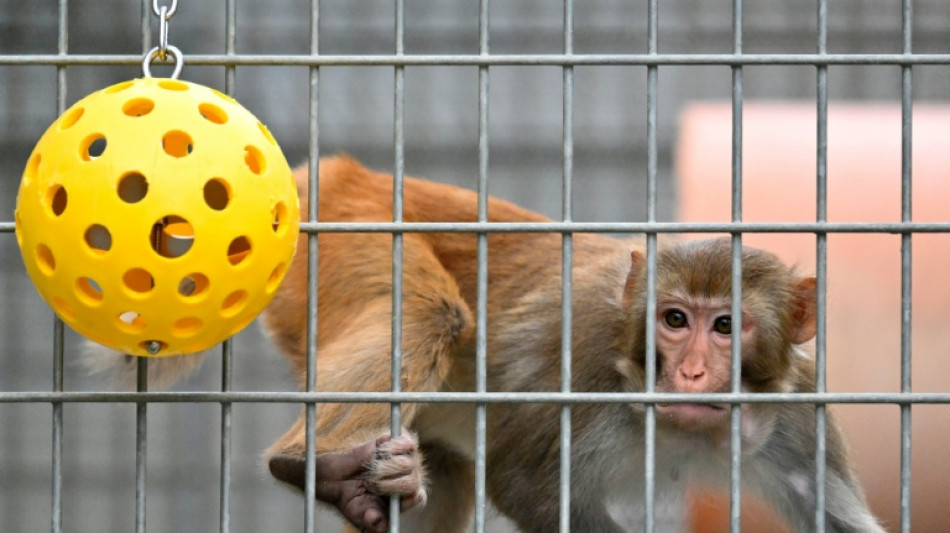
US medical agency will scale back testing on monkeys / Photo: Christophe SIMON - AFP/File
 Panama Canal begins reducing crossings due to El Nino
 Trump again seeks to remove protections for wolves

 'Getting there' - Alcaraz into US Open last 16 along with Sabalenka

 Isak ready to show world his quality, says Van Dijk

 Stuttgart cruise past Cologne to bounce back from Bayern thumping

 'Smart, aggressive' Alcaraz into US Open last 16

 Isak fires Liverpool to first win under Iraola at Ipswich

 Stocks slip as robust US jobs data stokes rate hike odds
 Mistrial declared in case of US woman who killed her three children

 Seville, Alfred win at Diamond League finals, Duplantis hit with injury

 Moody’s Assigns First-Time Insurance Financial Strength Ratings to Freedom Insurance and Freedom Life

 Trump says envoys taking plan to 'end the war' to Moscow, Kyiv

 US Football Hall of Fame revamps selection process

 Judge declares mistrial in case of US woman who killed her children

 Edgar Davids art thief misses sentencing after being 'knocked out by luggage'

 Pegula rallies to reach US Open fourth round

 Defending champ Sabalenka leads way into US Open fourth round

 Bayeux Tapestry 'virtually unchanged', UK museum says, after France spots broken threads

 More than 120 killed in Yemen's worst clashes in years: sources

 Germany hunts climate activist suspected of power grid sabotage

 5 EU countries aim to send rejected migrants to 'return hub' by 2027

 Argentina to return Nazi-looted painting to Jewish collector's heir

 Australian Simmons makes NBA comeback with Kings: reports

 Two broken threads on Bayeux Tapestry, no major damage: French minister

 Meloni marks record in power with eye on 2027 elections

The United States will scale back certain drug-safety testing requirements on monkeys, federal regulators said Tuesday, marking the latest step by President Donald Trump's administration to limit the use of animals in research.
Under new draft guidance from the Food and Drug Administration, computer models, lab-grown mini-organs, and human studies will replace the use of non-human primates in testing monoclonal antibodies -- lab-engineered proteins used to treat cancers, autoimmune conditions and other diseases.
"We are delivering on our roadmap commitment to eliminate animal testing requirements in drug evaluation and our promise to accelerate cures and meaningful treatments for Americans," FDA Commissioner Marty Makary said in a statement.
The statement added that typical nonclinical programs involving monoclonal antibodies could include more than 100 macaque monkeys -- apes are no longer used in any invasive research in the US -- yet often do not yield human-approved treatments.
The move was welcomed by animal-advocacy groups.
Zaher Nahle, a former animal researcher who is now the senior scientific advisor for nonprofit Center for a Humane Economy, told AFP the move was an "important step."
"These primates are not reliable in terms of predicting the toxicity, so you can get at least equal or better results in terms of your accuracy in predicting toxicology using other approaches," he added.
What's more, he noted, studies show that more than 90 percent of drugs deemed safe and effective in animals fail to win approval for human use.
The FDA's announcement follows a report in the journal Science last month that the Centers for Disease Control and Prevention would close its primate labs.
It "moves us one step closer to wiping out the federal government's wasteful monkey business," Justin Goodman of White Coat Waste Project told AFP.
But the National Institutes of Health -- the country's primary biomedical research agency -- remains a notable "outlier," he added. According to public data, 7,700 primates are confined in federal government labs and breeding facilities, of which 6,700 are at NIH.
Advocates of animal research have pushed back.
"Poorly planned transitions -- including premature study termination -- can place animals at serious risk and may undermine years of scientific investment intended to strengthen public health preparedness and advance lifesaving medical progress," advocacy group Americans for Medical Progress said after the CDC news was reported.
Proponents of animal testing say the research has been indispensable for major medical advances, including vaccines for diphtheria, yellow fever, measles and Covid-19.
Critics counter that decades-old laws have created regulatory lock-in, that publication incentives reward animal studies in top journals, and that a lucrative "animal-industrial complex" has helped entrench the status quo.
D.Kaufman--AMWN