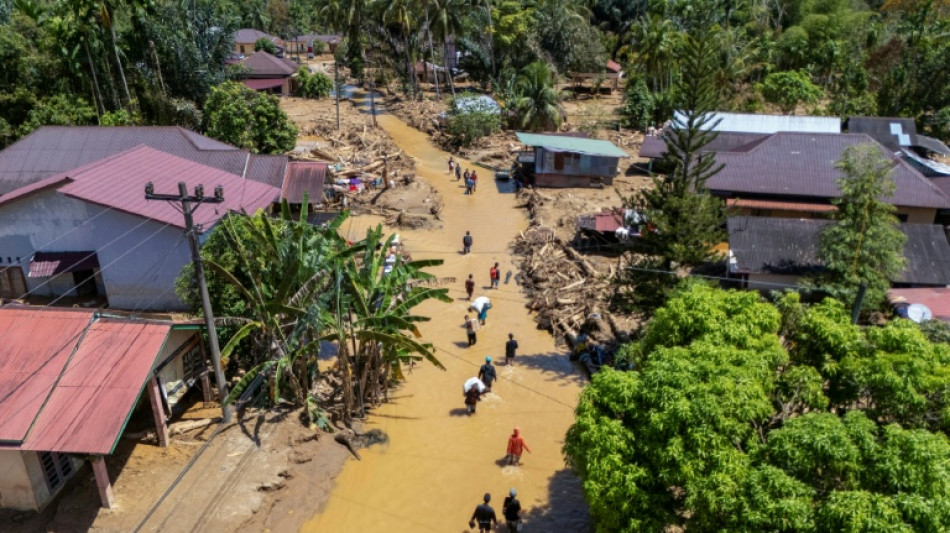
Indonesia floods were 'extinction level' for rare orangutans / Photo: YT Hariono - AFP
 How five Boeing 777s linked Madagascar's power elite to Iran

 South Korea proposes holding border talks with North

 Ukraine's young figure skaters twizzle on despite Russian threat

 Asian football endorses Infantino re-election as FIFA president

 Complete Kane hopes for 'special night' as Ballon d'Or rumours swirl

 Rooney calls United squad 'selfish babies' after Fernandes criticism

 Teddy Wilson, son of World Cup-winner David, gets Wallabies call-up

 New Zealand military chief resigns over 'inappropriate relationship'

 Man Utd's Carrick on borrowed time, free-scoring Brighton face Liverpool
 Asian stocks head into weekend on a low as tech extends losses

 'Generational rage': Young Europeans fight to be heard

 Lula, Bolsonaro to clash once more before Brazil vote

 Dressed to kill: Haircuts cap menacing look of Japan's yakuza

 Napa Valley's wineries feel Trump's tariff squeeze

 Venezuela protests demand return of Nobel winning leader Machado

 Marquez tops incident-packed opening practice for Australian MotoGP

 New York votes to ban Central Park horse carriages after decades of debate

 What Does a Race-Ready Bike Actually Cost?

 Eylsia Nicolas Hits #1 in the United States as Her Multi‑Category Chart Sweep Extends Across Global All‑Genres and International Markets

 Australia face selection headaches after 'shambolic' South Africa defeat

 Around 150,000 rally in Belgrade as Serbia heads to pivotal poll

 Hamilton sets sights on racing in African grand prix

 Bournemouth hammer 10-man Milan, Juventus denied at the death

 Judge orders Trump to give deposition in BBC lawsuit by Dec 11

 'Fake' pollsters hit US midterms

Indonesia's deadly flooding was an "extinction-level disturbance" for the world's rarest great ape, the tapanuli orangutan, causing catastrophic damage to its habitat and survival prospects, scientists warned on Friday.
Only scientifically classified as a species in 2017, tapanulis are incredibly rare, with fewer than 800 left in the wild, confined to a small range in part of Indonesia's Sumatra.
One dead suspected tapanuli orangutan has already been found in the region, conservationists told AFP.
"The loss of even a single orangutan is a devastating blow to the survival of the species," said Panut Hadisiswoyo, founder and chairman of the Orangutan Information Centre in Indonesia.
And analysis of satellite imagery combined with knowledge of the tapanuli's range suggests that the flooding which killed nearly 1,000 people last month may also have devastated wildlife in the Batang Toru region.
The scientists focused on the so-called West Block, the most densely populated of three known tapanuli habitats, and home to an estimated 581 tapanulis before the disaster.
There, "we think that between six and 11 percent of orangutans were likely killed," said Erik Meijaard, a longtime orangutan conservationist.
"Any kind of adult mortality that exceeds one percent, you're driving the species to extinction, irrespective of how big the population is at the start," he told AFP.
But tapanulis have such a small population and range to begin with that they are especially vulnerable, he added.
Satellite imagery shows massive gashes in the mountainous landscape, some of which extend for more than a kilometre and are nearly 100 metres wide, Meijaard said.
The tide of mud, trees and water toppling down hillsides would have carried away everything in its path, including other wildlife like elephants.
David Gaveau, a remote sensing expert and founder of conservation start-up The Tree Map, said he was flabbergasted by the before-and-after comparison of the region.
"I have never seen anything like this before during my 20 years of monitoring deforestation in Indonesia with satellites," he told AFP.
The devastation means remaining tapanulis will be even more vulnerable, with sources of food and shelter now washed away.
Over nine percent of the West Block habitat may have been destroyed, the group of scientists estimated.
In a draft paper shared with AFP and set to be published as a pre-print in coming days, they warned the flooding represents an "extinction-level disturbance" for tapanulis.
They are urging an immediate halt to development in the region that will damage remaining habitat, expanded protected areas, a detailed survey of the affected area and orangutan populations and work to restore lowland forests.
The highland homes currently inhabited by tapanulis are not their preferred habitat, but it is where remaining orangutans have been pushed by development elsewhere.
Panut said the region had become eerily quiet after the landslides.
"This fragile and sensitive habitat in West Block must be fully protected by halting all habitat-damaging development," he told AFP.
A.Jones--AMWN