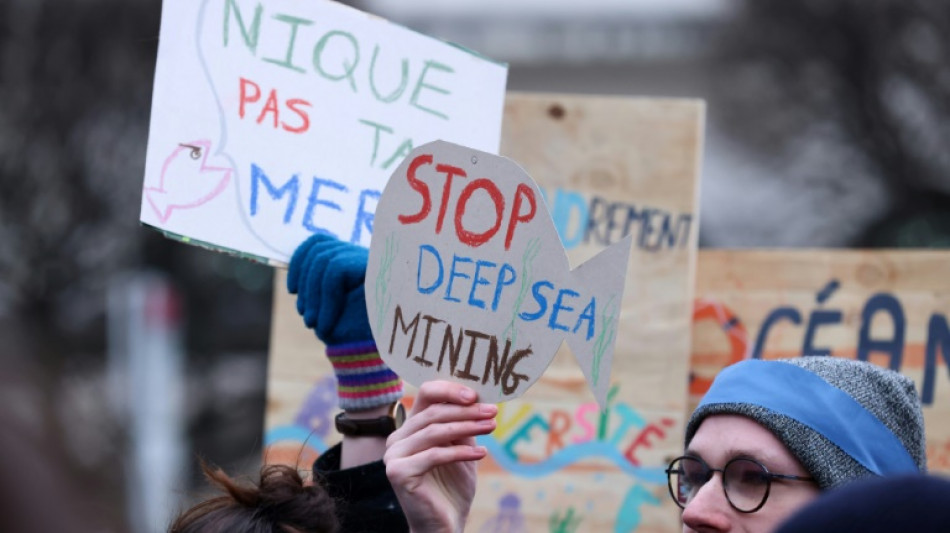
'Sound science' must guide deep-sea mining: top official / Photo: Kenzo TRIBOUILLARD - AFP/File
 Hospitality leaders ask Burnham to halve VAT amid rising costs

 Worcestershire invited to nominate groups for 2027 King’s volunteer award

 Just add fish: Scientists pursue more rice, less disease in Senegal paddies

 Louisville adds LJ Wells for fifth season of eligibility

 Florida State dismisses athletics director Alford and appoints interim leader

 Saudi Arabia warns it will react 'firmly' to Houthi attacks

 Designer Bob Mackie dies at 87 after career spanning television, stage and fashion
 'Widow's Bay' and 'The Pitt' win big at Emmy Awards

 China retail sales growth weakens further in August

 Eala to Yu Zidi: Six emerging stars set to light up Asian Games

 Brady and Bündchen’s former Brentwood estate combined luxury and resource-saving systems

 In Kashmir, lake weeds mix with traditional art

 Chinese architect Ma Yansong melds nature with 'futuristic feel'

 Trump says he will decide whether US pursues Iran deal

 'Widow's Bay' and 'The Pitt' take key Emmy awards

 Television's A-listers glitter on Emmys red carpet

 US Supreme Court blocks Trump mail-in ballot restrictions

 Dodgers clinch playoff berth in bid for third straight World Series
 Doomers and boosters: who's who in the AI wars

 GAC presents autonomous trucks and MONTX concepts at Hannover show

 EU extends Russia sanction deadline

 Thai wildlife investigators track traffickers through social media

 InterContinental Hotels Group PLC Announces Transaction in Own Shares - September 15

 PRAAMS Launches AI Co-Investor 5.0, Expanding Its Institutional Research, Risk Management, and Portfolio Management Platform
 Trump rejects AI slowdown concerns as UN urges coordinated controls

Rules on deep-sea mining in international waters must be driven by "sound science" and built on consensus, the head of the body charged with regulating the divisive practice said Thursday.
Deep-sea mining in international waters involves taking minerals like nickel, cobalt and copper -- crucial for renewable energy technology -- from the sea floor.
But researchers and environmentalists have long warned it risks destroying habitats and species that are little understood, and could upset delicate processes in the ocean that affect climate change.
The seabed in international waters is governed by the International Seabed Authority (ISA), an independent body established under the UN Convention on the Law of the Sea.
The ISA's Council, which for now only grants exploration contracts, has been drawing up commercial exploitation rules for more than a decade. And they aim to adopt a mining code this year to govern the extraction of seabed resources in international waters.
The issue is highly contentious, with some member states keen to begin mining soon, while others want a moratorium or even an outright ban on seabed exploitation.
ISA Secretary-General Leticia Carvalho said any mining code developed this year must be driven by "transparency, environmental responsibility and equitable benefit-sharing".
"Sound science must underpin all decisions related to the deep seabed," she told an ocean meeting in Tokyo by video link.
The world paid little attention when the ISA, created in 1994, quietly began negotiating the mining code.
But the calendar has taken on urgency.
- Thorny questions -
Since July 2023, due to a legal clause invoked by the tiny Pacific island nation of Nauru, any country can apply for a mining contract in the name of a company it sponsors.
Nauru Ocean Resources Inc. (NORI), a subsidiary of Canada's The Metals Company (TMC), wants to begin mining polymetallic nodules in the Pacific as soon as 2026.
It plans to file an exploitation application by June this year, making the need for a code governing mining all the more pressing.
Thorny issues have yet to be resolved, including environmental rules and how to share profits from seabed resources dubbed a "common heritage of mankind."
An oceanographer by training, Carvalho can only guide member states as they decide whether and how to draft a code.
She said she would focus on "ensuring that decisions are grounded in science and built on consensus".
Warnings about the impact of mining gained strength with the discovery last year that oxygen was being released on the ocean floor not just by living organisms, but by polymetallic nodules that would be targeted by companies.
The findings have been rejected by the TMC, even though it helped fund the research, and follow-up work is ongoing.
Mining proponents point to the growing need for minerals to drive the renewable energy transition, and the problems associated with on-land exploitation -- including environmental degradation and rights abuses.
F.Schneider--AMWN