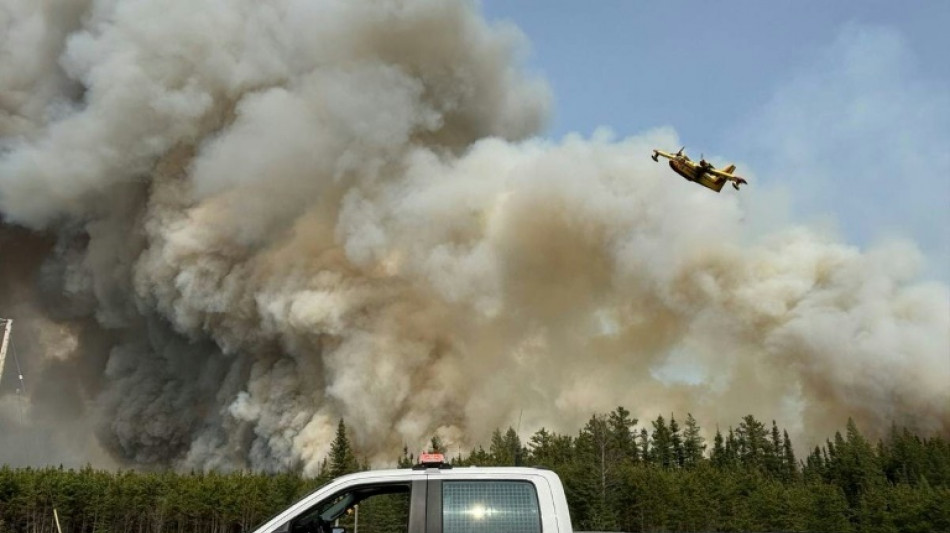
Experts warn Canada's wildfire season likely to be massive again / Photo: Handourt - Royal Canadian Mounted Police/AFP
 Hospitality leaders ask Burnham to halve VAT amid rising costs

 Worcestershire invited to nominate groups for 2027 King’s volunteer award

 Just add fish: Scientists pursue more rice, less disease in Senegal paddies

 Louisville adds LJ Wells for fifth season of eligibility

 Florida State dismisses athletics director Alford and appoints interim leader

 Saudi Arabia warns it will react 'firmly' to Houthi attacks

 Designer Bob Mackie dies at 87 after career spanning television, stage and fashion

 'Widow's Bay' and 'The Pitt' win big at Emmy Awards

 China retail sales growth weakens further in August
 Eala to Yu Zidi: Six emerging stars set to light up Asian Games

 Brady and Bündchen’s former Brentwood estate combined luxury and resource-saving systems
 In Kashmir, lake weeds mix with traditional art

 Chinese architect Ma Yansong melds nature with 'futuristic feel'

 Trump says he will decide whether US pursues Iran deal

 'Widow's Bay' and 'The Pitt' take key Emmy awards

 Television's A-listers glitter on Emmys red carpet

 US Supreme Court blocks Trump mail-in ballot restrictions

 Dodgers clinch playoff berth in bid for third straight World Series

 Doomers and boosters: who's who in the AI wars

 GAC presents autonomous trucks and MONTX concepts at Hannover show

 EU extends Russia sanction deadline

 Thai wildlife investigators track traffickers through social media

 InterContinental Hotels Group PLC Announces Transaction in Own Shares - September 15

 PRAAMS Launches AI Co-Investor 5.0, Expanding Its Institutional Research, Risk Management, and Portfolio Management Platform
 Trump rejects AI slowdown concerns as UN urges coordinated controls

Two years after a historically devastating summer, Canada is once again facing a massive fire season, with burned areas already exceeding year-to-date averages from recent years.
More than 220 active fires were burning across the country Tuesday, with half of them considered out of control.
More than 3.3 million hectares (12,700 square miles) have already been consumed by flames -- an area equivalent to the country of Belgium.
- A violent, early season -
Two provinces in central Canada -- Saskatchewan and Manitoba -- were hard-hit with rough starts to fire season, and had to declare a state of emergency at the end of May.
Now, more than a dozen new fires are detected daily across Canada -- often started accidentally by humans, but sometimes ignited by lightning strikes.
Mega wildfires are now burning in western Alberta and British Columbia, as well as in northern Ontario, the country's most populous province.
While these fires are consuming land at an alarming pace, they have not yet matched the numbers from 2023, an extraordinary year.
"It's quite spectacular what we're seeing right now," said Marc-Andre Parisien, a researcher at the Canadian Forest Service.
As such, the country is on maximum fire alert and resources are ready for mobilization, including army-led evacuations from remote areas.
International aid from Australia and the Unites States are also standing by.
- Fire weather conditions -
"There are some similarities to the 2023 fire season, particularly because we're again coping with a very large area experiencing water deficits and drought," Parisien said.
"Without the insulating effect of snow, the ground warmed up, vegetation dried more quickly, and conditions conducive to forest fires were established several weeks in advance," said Hossein Bonakdari, a University of Ottowa professor.
What's more, temperatures in May were above average across most of Canada.
In recent years, Canada has experienced warming at least twice as fast as the rest of the globe.
Linked to human-induced climate change, rising temperatures lead to reduced snow, shorter and milder winters, and earlier summer conditions that promote fires, experts say.
- Summer outlook -
Under current conditions, the fires are expected to last weeks or months, researchers say, warning that affected areas are so large that fires can smolder underground and reappear as temperatures rise.
"What is quite worrisome for the country is that we're experiencing a third consecutive year of intense fires with social consequences for thousands of evacuees but also significant ecological impacts," said Yan Boulanger, researcher for Canada's Ministry of Natural Resources.
While forest fires have a natural place in Canada's ecosystem, repeated blazes mean there is little time to regenerate in between fire seasons.
In some areas, the forest is beginning to disappear, making way for prairie landscapes, the researcher said.
Another source of concern for experts: the size of the fires, which are already enormous this month, long before the peak of the season.
For example, in Saskatchewan, the Shoe Fire already exceeds 500,000 hectares (1.2 million acres).
From that perspective, Boulanger said, "it's even more serious than 2023."
A.Mahlangu--AMWN