Top climate scientist declares 2C climate goal 'dead' / Photo: ANDY BUCHANAN - AFP/File
 Florida State dismisses athletics director Alford and appoints interim leader

 Saudi Arabia warns it will react 'firmly' to Houthi attacks

 Designer Bob Mackie dies at 87 after career spanning television, stage and fashion
 'Widow's Bay' and 'The Pitt' win big at Emmy Awards

 China retail sales growth weakens further in August

 Eala to Yu Zidi: Six emerging stars set to light up Asian Games

 Brady and Bündchen’s former Brentwood estate combined luxury and resource-saving systems
 In Kashmir, lake weeds mix with traditional art

 Chinese architect Ma Yansong melds nature with 'futuristic feel'

 Trump says he will decide whether US pursues Iran deal
 'Widow's Bay' and 'The Pitt' take key Emmy awards

 Television's A-listers glitter on Emmys red carpet

 US Supreme Court blocks Trump mail-in ballot restrictions

 Dodgers clinch playoff berth in bid for third straight World Series

 Doomers and boosters: who's who in the AI wars

 GAC presents autonomous trucks and MONTX concepts at Hannover show

 EU extends Russia sanction deadline

 Thai wildlife investigators track traffickers through social media

 PRAAMS Launches AI Co-Investor 5.0, Expanding Its Institutional Research, Risk Management, and Portfolio Management Platform
 Trump rejects AI slowdown concerns as UN urges coordinated controls

 US judge postpones new visa rules for foreign students, journalists

 Higher wages draw migrant workers to Kashmir despite attacks

 Oil supply concerns and AI warnings weigh on global markets

 'I am the hoax buster': Trump rejects AI danger warnings

 Macklemore dropped from Ed Sheeran tour after 'free Palestine' speech

Holding long-term global warming to two degrees Celsius -- the fallback target of the Paris climate accord -- is now "impossible," according to a stark new analysis published by leading scientists.
Led by renowned climatologist James Hansen, the paper appears in the journal "Environment: Science and Policy for Sustainable Development" and concludes that Earth's climate is more sensitive to rising greenhouse gas emissions than previously thought.
Compounding the crisis, Hansen and colleagues argued, is a recent decline in sunlight-blocking aerosol pollution from the shipping industry, which had been mitigating some of the warming.
An ambitious climate change scenario outlined by the UN's climate panel, which gives the planet a 50 percent chance of keeping warming under 2C by the year 2100, "is an implausible scenario," Hansen told a briefing Tuesday.
"That scenario is now impossible," said Hansen, formerly a top NASA climate scientist who famously announced to the US Congress in 1988 that global warming was underway.
"The two degree target is dead."
Instead, he and co-authors argued, the amount of greenhouse gases already pumped into the atmosphere by burning fossil fuels meant increased warming is now guaranteed.
Temperatures will stay at or above 1.5C in the coming years -- devastating coral reefs and fueling more intense storms -- before rising to around 2.0C by 2045, they forecast.
They estimated polar ice melt and freshwater injection into the North Atlantic will trigger the shutdown of the Atlantic Meridional Overturning Circulation (AMOC) within the next 20–30 years.
The current brings warmth to various parts of the globe and also carries nutrients necessary to sustain ocean life.
Its end "will lock in major problems including sea level rise of several meters -- thus, we describe AMOC shutdown as the 'point of no return,'" the paper argued.
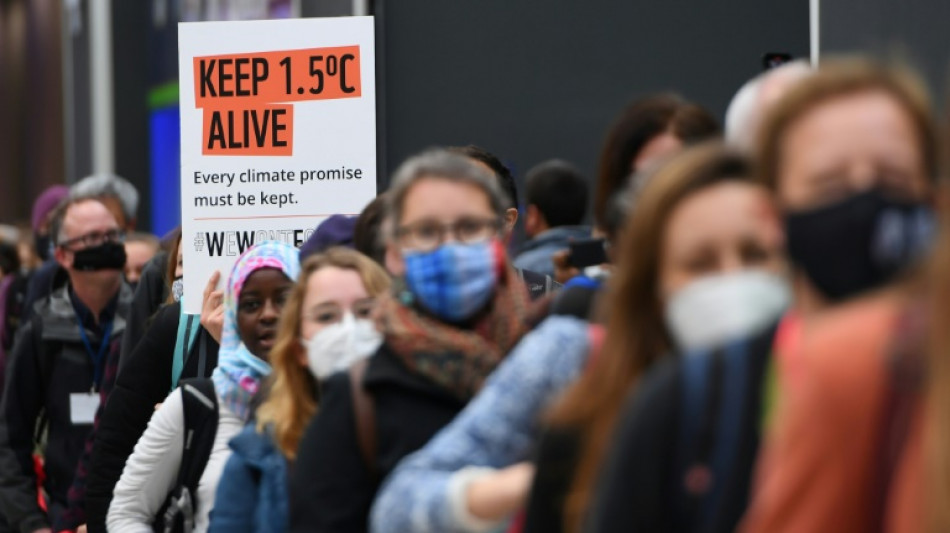
The world's nations agreed during the landmark Paris climate accord of 2015 to try to hold end-of-century warming to 1.5C above pre-industrial levels.
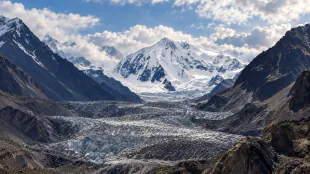
Scientists identified the threshold as critical to preventing the breakdown of major ocean circulation systems, the abrupt thawing of boreal permafrost, and the collapse of tropical coral reefs.
The 1.5C target has already been breached over the past two years, according to data from the EU's climate monitoring system Copernicus, though the Paris Agreement referred to a long-term trend over decades.
At 2C, the impacts would be even greater, including irreversible loss to Earth's ice sheets, mountain glaciers and snow, sea ice and permafrost.
The authors acknowledged the findings appeared grim, but argued that honesty is a necessary ingredient for change.
"Failure to be realistic in climate assessment and failure to call out the fecklessness of current policies to stem global warming is not helpful to young people," they said.
"Today, with rising crises including global climate change, we have reached a point where we must address the problem of special interests," they added, stressing they were "optimistic" for the future.
D.Moore--AMWN