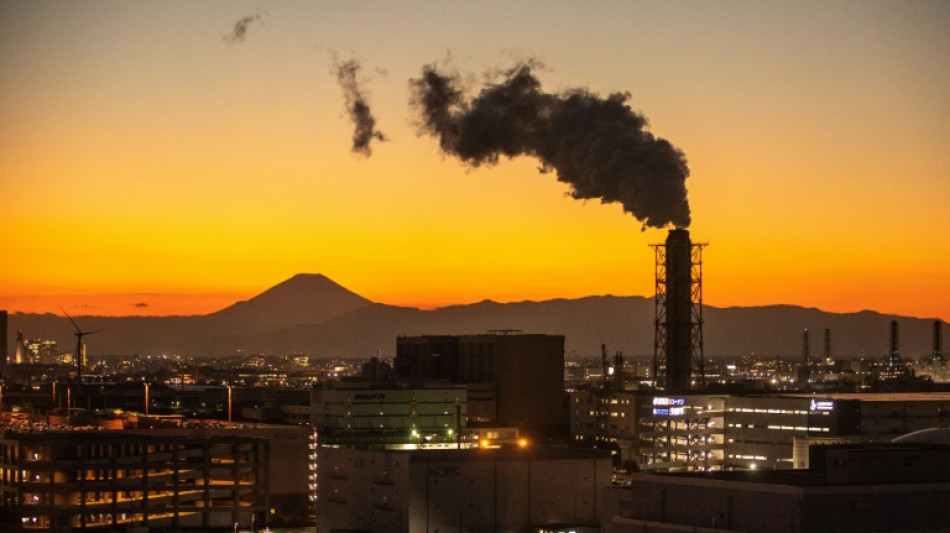
Japan targets 60% emissions cut by 2035 from 2013 levels / Photo: Philip FONG - AFP
 Florida State dismisses athletics director Alford and appoints interim leader

 Saudi Arabia warns it will react 'firmly' to Houthi attacks

 Designer Bob Mackie dies at 87 after career spanning television, stage and fashion
 'Widow's Bay' and 'The Pitt' win big at Emmy Awards

 China retail sales growth weakens further in August

 Eala to Yu Zidi: Six emerging stars set to light up Asian Games
 Brady and Bündchen’s former Brentwood estate combined luxury and resource-saving systems
 In Kashmir, lake weeds mix with traditional art

 Chinese architect Ma Yansong melds nature with 'futuristic feel'

 Trump says he will decide whether US pursues Iran deal
 'Widow's Bay' and 'The Pitt' take key Emmy awards

 Television's A-listers glitter on Emmys red carpet

 US Supreme Court blocks Trump mail-in ballot restrictions

 Dodgers clinch playoff berth in bid for third straight World Series
 Doomers and boosters: who's who in the AI wars

 GAC presents autonomous trucks and MONTX concepts at Hannover show

 EU extends Russia sanction deadline

 Thai wildlife investigators track traffickers through social media

 PRAAMS Launches AI Co-Investor 5.0, Expanding Its Institutional Research, Risk Management, and Portfolio Management Platform

 Trump rejects AI slowdown concerns as UN urges coordinated controls

 US judge postpones new visa rules for foreign students, journalists

 Higher wages draw migrant workers to Kashmir despite attacks

 Oil supply concerns and AI warnings weigh on global markets

 'I am the hoax buster': Trump rejects AI danger warnings

 Macklemore dropped from Ed Sheeran tour after 'free Palestine' speech

Japan set fresh climate targets on Tuesday, pledging to slash greenhouse gas emissions by 60 percent in the next decade from 2013 levels.
Under the Paris Agreement, each country is supposed to provide a steeper headline figure to the UN for cutting heat-trapping emissions by 2035, and a detailed blueprint for how to achieve this.
Japan's environment ministry said Tuesday it aims to slash emissions 60 percent by the 2035 fiscal year, which starts in April.
Tokyo also aims to cut emissions by 73 percent by the 2040 fiscal year, as part of its new Nationally Determined Contribution (NDC) -- a voluntary pledge to be submitted to the United Nations.
Nearly 200 nations had been required to deliver fresh climate plans by February 10 but just 10 did so on time, according to a UN database tracking submissions.
The environment ministry said on Tuesday that its "ambitious targets (are) aligned with the global 1.5 degree Celsius goal and on a straight pathway towards the achievement of net zero by 2050".
In 2016, Japan committed to a 26 percent reduction in emissions by 2030. But a renewed NDC issued in March 2020 had the same figure, sparking criticism from campaigners.
A more ambitious carbon cutting plan submitted in October 2021 set a goal of reducing emissions by 46 percent by 2030, compared to 2013 levels.
Global emissions have been rising, but need to almost halve by the end of the decade to limit global warming to safer levels agreed under the Paris deal.
Also on Tuesday, Japan approved its latest Strategic Energy Plan, which includes an intention to make renewables its top power source by 2040.
Nearly 14 years after the Fukushima disaster, Tokyo also sees a major role for nuclear power in helping Japan meet growing energy demand from artificial intelligence and microchip factories.
The world's fourth-largest economy has the dirtiest energy mix in the Group of Seven, campaigners say.
Nearly 70 percent of Japan's power needs in 2023 were met by power plants burning coal, gas and oil, a figure Tokyo wants to slash by 30 to 40 percent over the next 15 years.
Almost all must be imported, costing Japan about $500 million per day and representing a hurdle for the government's aim to reach carbon neutrality by 2050.
Under the new plans, renewables such as solar and wind are expected to account for 40 to 50 percent of electricity generation by 2040.
That marks a jump from last year's level of 23 percent and a previous target for 2030 of 38 percent.
P.Mathewson--AMWN