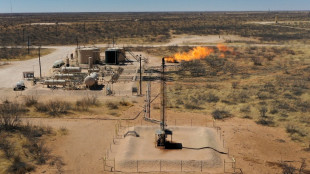
Court case challenges New Zealand's 'magical thinking' climate plans / Photo: KAVINDA HERATH - AFP
 Bolsonaro's escape to the US: How it happened

 Russell calls on Scotland to 'kick on' and beat big teams

 Airbus aims for record deliveries despite disappointing quarter

 Cuba wins UN vote against US embargo with weakest backing in 30 years

 Real Madrid, La Liga apology over Mbappe shows power of Chinese market

 From Gaza to Ramallah, Palestinians see little hope in Israeli vote
 US labor leader Dolores Huerta dead: family

 Investors turn cautious ahead of tech results, Fed update on rates

 'Cruise for life' strands passengers in Cambodia as operator goes bust

 Bolsonaro flees Brazil for US after election defeat

 A throne on wheels, popemobiles star in new Vatican show

 Spain high-speed train crash kills 68, injures over 100

 UK woman drugged by husband tells rape trial she woke up bound

 Clean-up starts as Serbian students movement prepares to govern

 Flavio Bolsonaro: right-wing heir falls from presidential hopeful to exile

 UK budget lifts bank tax to offset surging energy bills

 Spain high-speed train collision kills 64, injures over 100

 Brazil's Bolsonaro lands in Florida after election defeat: AFP

 Russia woos African leaders at Moscow summit

 Local ceasefire in Russia-occupied Ukrainian city holds for second day

 Odegaard urges Arsenal to move on after Fleetwood upset

 Japan, Germany leaders target closer ties on critical minerals

 Spain high-speed train collision kills 31, injures 80
 Turkey hosted Libya east-west reunification talks last week

 Spain high-speed train collision kills 30

New Zealand, which attracts millions of tourists each year with its pristine nature and spectacular landscapes, is facing a legal challenge over "magical thinking" in its climate promises.
After unravelling a string of green policies since it came to power in 2023, the right-leaning government is accused of relying too heavily on unproven future technologies to meet its legally binding carbon emission targets.
Lawyers for Climate Action and the Environmental Law Initiative took Climate Change Minister Simon Watts to court in March, arguing the government was not doing enough.
Watts has declined to comment because the matter is before the courts, with a decision due later this year.
New Zealand's goal, enshrined in law, is to have net-zero greenhouse gas emissions by 2050, excluding methane produced by waste and agriculture.
Wellington sets five-yearly targets to meet its goal, which was passed overwhelmingly by lawmakers in 2019.
Lawyers for Climate Action co-founder James Every-Palmer, a senior barrister, told AFP the five-yearly climate budgets were "an extremely important part of the parliamentary response to climate change".
But the centre-right ruling coalition has rolled back key climate policies put in place by the previous Labour government of Jacinda Ardern.
- Law and magic -
It cancelled a clean car discount incentivising electric vehicle uptake, reversed a ban on oil and gas exploration, and began a fast-track scheme for mining permits.
In January 2025, the government said it aimed to reduce carbon emissions by 51 percent from 2005 levels by 2035 -- barely changed from a 50-percent cut targeted for 2030.
Every-Palmer said Wellington now risked missing its legislated targets, and exceeding its so-called climate budget.
"The minister has a legal obligation to ensure that the budget's met," he said.
"The government's own analysis was that effectively it was a coin-toss chance that we would meet the targets."
Instead, it has announced an "adaptive management policy", which Every-Palmer characterised as meaning that "if things are going off the rails, we will look at what we can do at the time".
That risks waiting to do something until it is too late to stay on track for the 2050 goal, he said.
"It's fine to have policies that you implement if you need them, but they have to be real policies," he said.
"They can't be just magical thinking that we'll come up with something at the time."
He and other campaigners argue the government is relying too heavily on theoretical technologies to mitigate climate change.
He cited Wellington's decision to invest in science and businesses seeking to build methane-reducing, carbon capture, and green hydrogen technologies in the future.
- 'Back to reality' -
The case is part of a growing body of climate litigation around the world, with courts from South Korea to Germany pushing governments to take climate change more seriously.
The German decision in 2021 found the government's plans were unconstitutional because they relied too much on future developments, leaving much of the emissions-cutting burden to the next generation.
"The law generally doesn't have much truck with magic," said Jenny Cooper, another senior barrister and co-founder of Lawyers for Climate Action.
"That's one of the reasons why we see litigation as quite a good way to air these issues and bring them back to reality."
Y.Kobayashi--AMWN