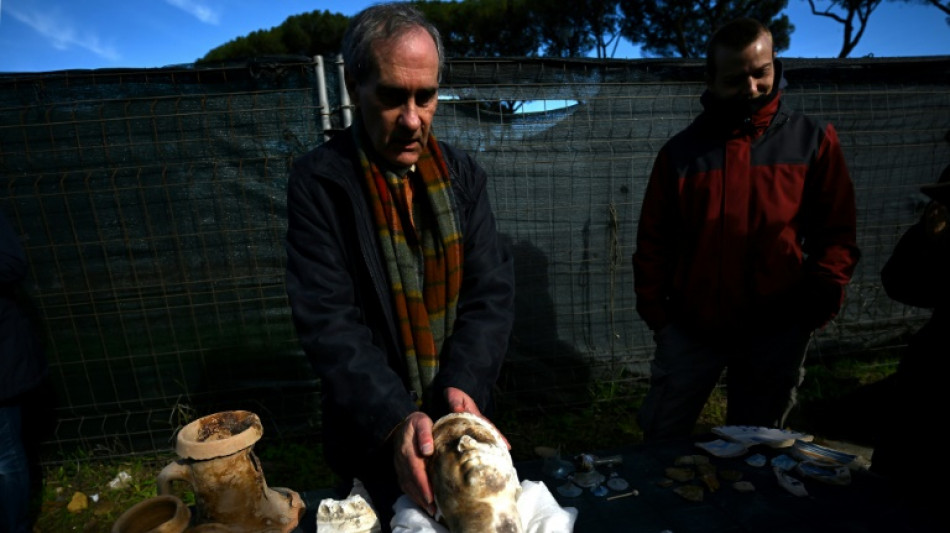
Rome's Appian Way eyes UNESCO status / Photo: Filippo MONTEFORTE - AFP
 Chelsea beat Brighton in seven-goal thriller, Leeds hold Brentford

 At least seven die in ferry capsize off Northern Cyprus; 23 missing

 In-form Marc Marquez wins Aragon MotoGP Grand Prix

 At least six die in ferry capsize off Northern Cyprus

 Niamey back to normal after soldier mutiny
 King Haakon joins Norway memorials for Harald

 NASA launches Roman telescope on cosmic mapping mission

 Van Dijk wants Gakpo to stay at Liverpool amid Man City interest

 Five-wicket Abbas has Lord's landmark as Pakistan set 389 to win second Test

 Tadej Pogacar Out of Vuelta a Espana with Broken Collarbone and Concussion

 Iceland votes 'No' to resuming EU talks

 Berlin Literary Guide: Book Launches, Festivals, and Readings Through August

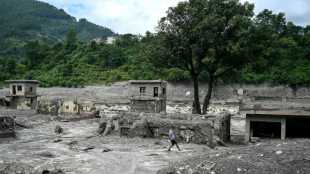 Nepal rescuers drill through debris towards trapped tunnel workers

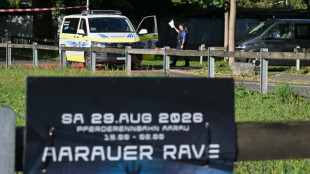 Manhunt in Switzerland after fatal rave shooting

 'No' camp seen winning Iceland's EU referendum

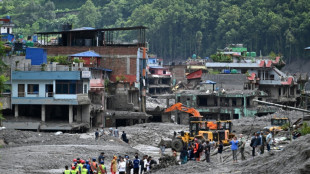 Nepal flood survivors return to ruins to salvage memories

 Killing of Palestinian children and teens by Israel surges in West Bank

 Educators keep 9/11 memory alive for next generation, 25 years on

 Venezuelans view US oil deal with doubt, hope

 Gobena and Jepchirchir power to Sydney Marathon victories

 Iceland in suspense after close EU vote

 Wallabies hold on for victory in Argentina

 Juve notch second straight win, Fiorentina's centenary party falls flat

 Rybakina eases injury fears ahead of US Open
 Djokovic kicks off latest Grand Slam quest under US Open lights

All roads lead to Rome, as the saying goes, and the most prestigious is the Appian Way, the strategic highway for the Roman Empire now hoping to become a UNESCO World Heritage Site.
A paved road of more than 500 kilometres (310 miles) begun in 312 BC by Roman statesman Appius Claudius Caecus, the "Via Appia" is an archaeological treasure trove.
The artery leading south to the key port of Brindisi at Italy's heel provided a gateway to the eastern Mediterranean, especially Greece, and was of strategic importance for the armies and merchants of a quickly expanding Rome.
This week, archaeologists showed off progress in their attempt to dig deep enough to unearth part of the first mile of the road, hidden far underground near Rome's Baths of Caracalla.
"What we see today is the result of an excavation that began in July with the central goal of finding clues to the location of the first section of the Appian Way," said archaeologist Riccardo Santangeli Valenzani.
The first, earliest section of the road is the one that provides "the most problems regarding the precise and exact location", the professor at Roma Tre University cautioned.
Construction of the Appian Way required Herculean engineering, from the levelling of the land, building of ditches and canals and surfacing of the road with gravel and heavy stone, to the building of post offices and inns to support the thousands of soldiers and merchants headed southward.
- Digging deeper -
Wandering today along the Appian Way --- its massive blocks of paving stone still visible in sections -- is to take a trip through the past.
Imposing monuments such as the first century BC tomb of a consul's daughter, Cecilia Metella, sit alongside ancient catacombs and churches, crumbling tombstones of Roman families and leafy villas.
The Appian Way sheds light not only on the Roman Republic and later Roman Empire, but also on life and death in the Middle Ages with its pilgrimage shrines and crypts.
The road also provides a glimpse of modern architectural wonders, such as the sumptuous villas owned by Italy's rich and famous, including the late film legend Gina Lollobrigida or former premier Silvio Berlusconi.
Italy, which earlier this month presented its bid for the Appian Way to UNESCO, already has 58 sites recognised as World Heritage Sites, the most of any country.
They include entire historical city centres, such as Rome, Florence and Venice, and archaeological areas such as the ruins of Pompeii and Herculaneum.
Work to locate the initial stretch of the Appian Way, believed to be some eight metres underground, has so far been complicated by groundwater.
Nevertheless, digging in higher strata of ground has unearthed relics from different periods, including a marble bust from the second century AD and an early papal square coin, minted between 690 and 730.
Archaeologists have also found fragments of glass and ceramics, mosaic and bits of amphora.
So far, the excavation has reached residential or commercial structures dating from the time of Emperor Hadrian, who died in 138 AD.
Archaeologist Daniel Manacorda said the current excavation had reached the point of "late ancient Rome, the one that began to live in the ruins of ancient Rome".
"If we could continue to dig deeper, we would find archaic Rome," he said.
D.Kaufman--AMWN