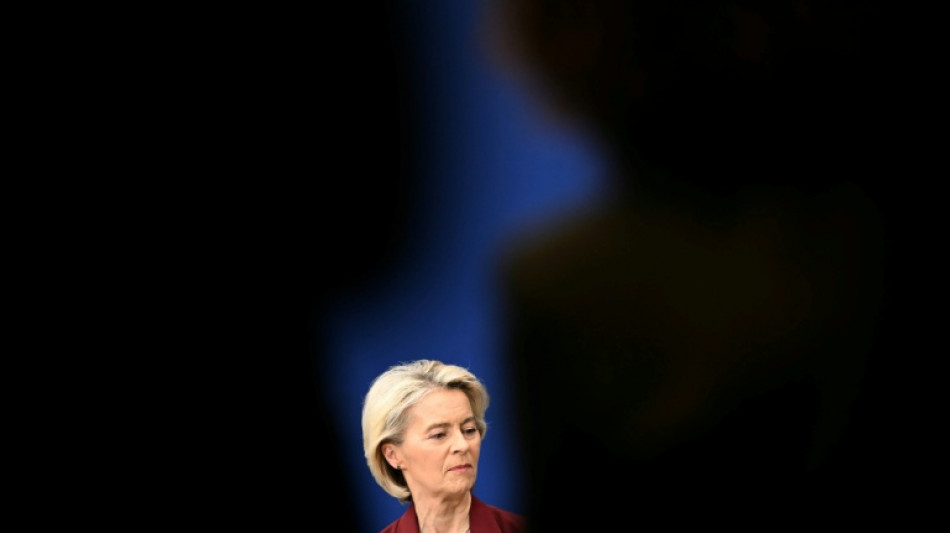
EU presents plan to use Russian assets for Ukraine as Belgium frets / Photo: NICOLAS TUCAT - AFP
 North Korean women crowned Asian club champions in South

 Full steam ahead for Milei's Andean mining revolution
 Rubio in India to renew ties after Trump's China lovefest

 China set for latest space launch, with Hong Kong astronaut aboard
 US jury finds Boeing not guilty in 737 MAX grounding lawsuit
 Rubio starts first visit to India on heels of US-China summit
 'Never going back': Cartel attack decimates Mexican Indigenous town

 The movies vying for the Cannes Film Festival's top prize
 Banned ex-100m champ Kerley to compete clean at Enhanced Games

 Senegal's president sacks PM after months of tensions
 US mulls new strikes on Iran: US media reports

 SpaceX sends Starship rocket sailing into space

 Russell bounces back to beat Antonelli in sprint qualifying

 Mexico, EU lower tariffs in bid to grow non-US trade

 Fresh confrontation between police, protesters in Bolivia
 US Fed chair says will be 'reform-oriented' at glitzy White House swearing-in

 Ace, eagle lift Im to early CJ Cup Byron Nelson lead
 Antonelli romps opening practice ahead of Russell
 Pakistan military chief arrives in Tehran in push to end Iran war

 US intelligence chief Tulsi Gabbard resigns
 Pep 'made me believe I could be a coach', says Kompany

 Rising Spain star Jodar wants to 'follow own path' at Roland Garros
 Success fuels Guardiola's campaign for a 'better society'
 SpaceX to retry Starship test launch Friday
 Stocks gain, oil higher as investors weigh Mideast peace prospects

The EU on Wednesday laid out a plan to use frozen Russian assets to help fund Ukraine with 90 billion euros over the next two years, despite outspoken opposition from key player Belgium.
The European Union's executive has been drawing up options to help plug Kyiv's looming budget black holes as Russia's punishing invasion drags on towards a fourth year.
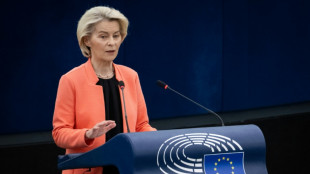
"Today we are proposing to cover two-thirds of Ukraine's financing needs for the next two years," European Commission President Ursula von der Leyen told journalists as she presented the legal proposal for the plan.
"So this is 90 billion euros ($105 billion) -- the remainder would be for international partners to cover."
Von der Leyen said the money would be generated either from EU borrowing or by using Russian central bank assets frozen in the bloc to fund a "reparations loan", the option pushed by her commission and multiple member states.
She said the financing would allow Kyiv to "lead peace negotiations from a position of strength" as the United States pushes to end Russia's war.
EU leaders have already pledged to keep Kyiv afloat next year and officials insist they are determined to reach an agreement on where the money should come from at a December 18 summit.
But Belgium, home to international deposit organisation Euroclear, which holds the vast bulk of the Russian assets, has so far rejected the plan over fears it could face crippling legal and financial retribution from Russia.
Belgian Foreign Minister Maxime Prevot said the legal texts put forward by von der Leyen "do not address our concerns in a satisfactory manner".
"We have repeatedly said that we consider the option of the reparations loan the worst of all, as it is risky, it has never been done before," Prevot said.
"This explains why we keep on pleading for an alternative, namely the EU borrowing the amounts needed on the markets."
- 'Three-tier defence' -
The Belgian government has insisted it wants solid guarantees from other EU countries that they will share the liability.
The commission insisted that it has put in place a "three-tier defence" to help shield Belgium from any legal jeopardy.
It also said that it was looking to tap not only Russian assets held in Belgium, but also some 25 billion euros in other EU countries.
The initial size of the plan appears to have been scaled back from an original 140-billion-euro loan floated by the commission.
EU economy chief Valdis Dombrovskis said overall there was 210 billion euros in Russian assets that could be tapped, but the rest would only be drawn from later if needed.
Under the complex scheme proposed by the EU, the loan would only be paid back by Ukraine if and when Russia compensates Kyiv for the destruction it has wrought.
Despite its strong resistance, Belgium may ultimately not be able to withstand the push to use the frozen Russian assets.
Von der Leyen said that the initiative could be approved by a weighted majority of EU countries and would not require unanimity.
Most other EU states back the plan and insist that a solution can be reached.
"They are justified, but the issue is solvable. Solvable if we stand together and are willing to take responsibility."
J.Oliveira--AMWN